
This Holy Week, I was not in North America. I was in Jerusalem, on the Mount of Olives, in the Garden of Gethsemane, in the Old City, standing on the very ground where the events we commemorate actually happened. I want to tell you why that matters, and why it was a privilege I do not take lightly.
The world is watching Jerusalem. So should we.
Why Go?
I have visited the Holy Land before. Each visit has deepened my understanding of Scripture and sharpened my sense of what is at stake, spiritually, historically, and humanly in the land God called His own. This year, with Jerusalem in the shadow of ongoing war, many Western leaders and pilgrims stayed away. The Old City was quieter than usual. Wartime restrictions had reduced even the great liturgies of Holy Week at the Church of the Holy Sepulchre to a handful of clergy.
And yet I believe this is precisely when the Church must be present. Not as a political statement. Not as tourism. But as a witness. As those who believe that what happened in Jerusalem two thousand years ago is the most important series of events in human history, we ought not to absent ourselves when Jerusalem suffers. The Lord of the Church did not absent Himself from Jerusalem’s suffering. He walked straight into it.
The Videos: Praying the Collects on Holy Ground
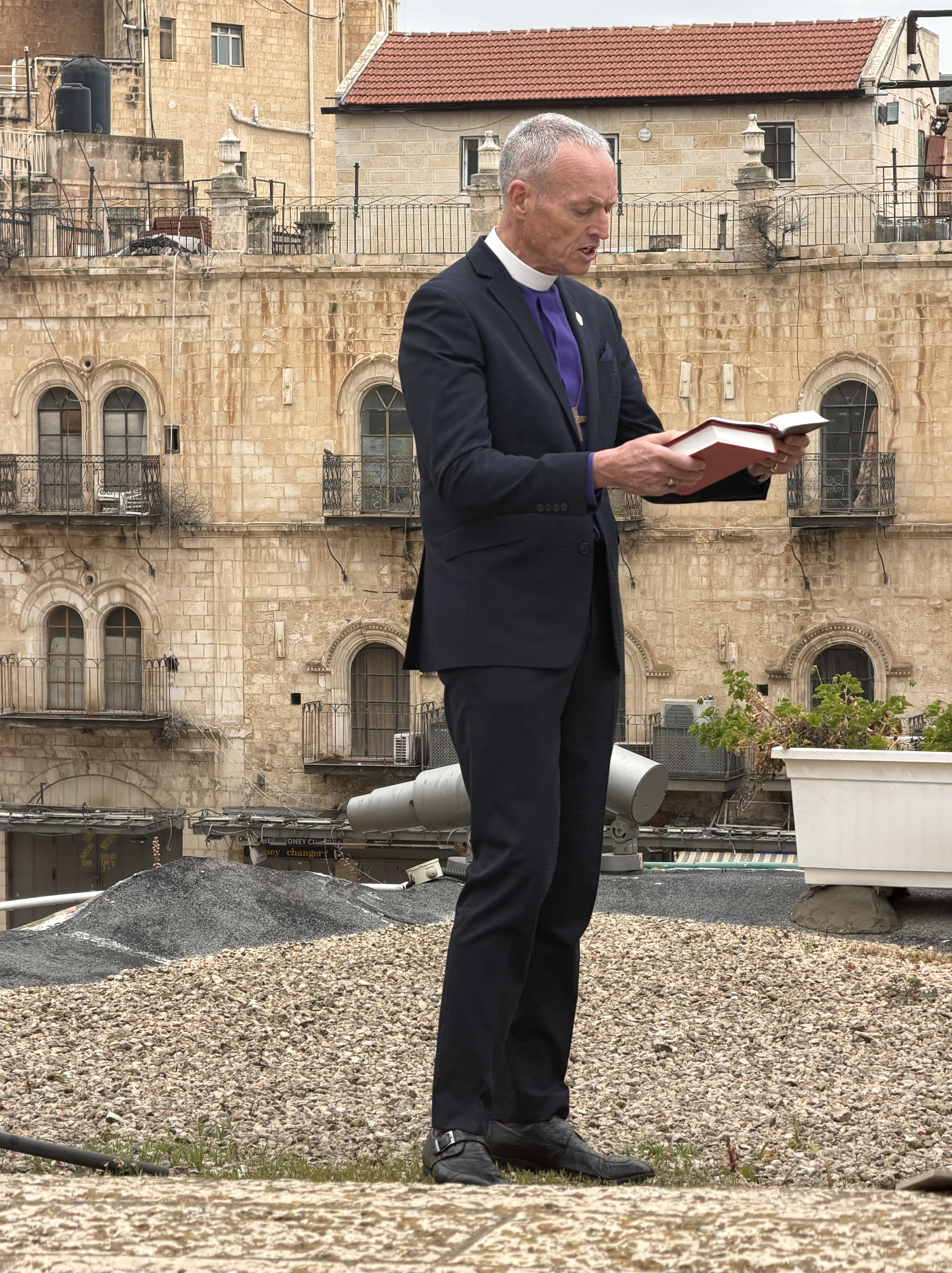
During Holy Week, I filmed a series of short video devotionals from the Gospel sites, each episode recorded on location at a place corresponding to the events of that liturgical day, and each closing with the appointed collect from the Book of Common Prayer. The series was published in partnership with Christ Church Jerusalem and shared across the ACNA’s YouTube and Facebook channels.
On Holy Wednesday, I filmed from the Mount of Olives and led the collect:
“Assist us mercifully with your grace, Lord God of our salvation, that we may enter with joy upon the meditation of those mighty acts by which you have promised us life and immortality through Jesus Christ our Lord, who lives and reigns with you and the Holy Spirit, one God forever and ever. Amen.”
On Maundy Thursday, I stood among the ancient olive trees of Gethsemane. There I reflected on the Last Supper, the foot-washing, and our Lord’s agonized prayer: “My Father, if it be possible, let this cup pass from me. Nevertheless, not as I will, but as you will” (Matthew 26:39, ESV). To stand in that garden is to feel the weight of those words in a way that no commentary can quite replicate. I closed with the words of Saint Paul: “Be watchful, stand fast in the faith, act like men, and let all that you do be done in love” (1 Corinthians 16:13–14, ESV).
The aim of the series was simple: to bring the Church with me. If you could not travel to Jerusalem, I wanted you to walk the streets with me through your screen, and to pray the ancient collects of our tradition as if you were standing there too. The Book of Common Prayer was written to be prayed by the whole Church, in every place. There is something fitting about praying it from the very streets where the Gospel was first lived.
Christ Church Jerusalem: An Anglican Home in the Holy City
I am deeply grateful to my friend the Rev. David Pileggi and the congregation of Christ Church Jerusalem, without whose hospitality and partnership this ministry would not have been possible.
Christ Church is the oldest Protestant church in the Middle East. Consecrated on 21 January 1849, it was built by the Church’s Ministry Among Jewish People (CMJ), then called the London Society for Promoting Christianity Amongst the Jews, whose founders included William Wilberforce himself. From its earliest days it was known as the “Jewish Protestant Church,” built not to erase the Jewish origins of the faith but to honor them: its interior faces the Temple Mount, its windows bear Hebrew inscriptions, and its walls carry the Jewish symbols that remind every worshiper that our faith is rooted in God’s covenant with Israel. Historian Stephen Neill called its founding “one of the strangest episodes of modern church history” strange, perhaps, to the world; faithful, I would say, to Scripture.
The Anglican connection to Jerusalem runs deep and long. The first Anglican Bishop of Jerusalem, Michael Solomon Alexander, was himself a Jewish believer, a former rabbi who came to faith in the Messiah Jesus and was consecrated bishop in 1842. From those earliest days, Anglicanism in the Holy Land was shaped by a conviction that the Church owes an immense spiritual debt to the Jewish people, and that the Gospel of the Messiah was, from the beginning, good news to the Jew first.
Today, Christ Church continues that witness and even in wartime, even with reduced numbers and heightened security, Christ Church was open and faithful this Holy Week. I am honored to call it a sister congregation and a partner in the Gospel.
A Word on Antisemitism
I cannot write about Jerusalem without addressing what I observed and what I believe the Church must say plainly: antisemitism is a sin, and it has no place among the people of God.
The current conflict has, in many parts of the world, stirred up a deeply troubling resurgence of hatred toward Jewish people. I have previously visited Israel in the aftermath of the October 7, 2023 massacre, meeting Jewish families who had lost loved ones, Palestinian Christians navigating an impossibly painful situation, and communities living under the shadow of violence. What I saw then and what I see now is that the hatred directed at Jewish people is not merely political. It is spiritual in its origins and demonic in its expression.
Christians must be clear. We worship a Jewish Messiah. Our Scriptures were given through the Jewish people. To hate the Jewish people is to be at war with the purposes of God. I call on every Christian, every congregation, and every leader across our Province and beyond: stand against antisemitism without equivocation. Name it. Reject it. And pray, as we are called to pray, for the peace of Jerusalem (Psalm 122:6).
Why It Matters to Stand on the Ground
Some people might wonder if it was really necessary to go to Jerusalem to preach during Holy Week. Could I preach from home?
Of course I could. The Gospel does not require geography. The crucifixion and resurrection of the Lord Jesus Christ are true whether they are proclaimed from Jerusalem or from New Jersey.
And yet.
When you stand on the Mount of Olives and look across the Kidron Valley toward the Old City, you are standing where our Lord stood as He wept over Jerusalem. When you step into the Garden of Gethsemane and see olive trees that were already ancient when He knelt among them, you feel the reality of the Holy Week press in on you differently. These are not merely symbolic sites. They are places where God, in the flesh, was present. Where He bled. Where He was arrested. Where He was buried. Where He rose.
The Holy Week gospels are not a collection of ideas. They are the account of things that happened, in real places, at real times, in the real city of Jerusalem. We should visit those places. We should stand on that ground. We should pray the ancient collects of our tradition on the very streets where the events they commemorate took place.
And when the world says it is too dangerous, too complicated, too political, we should go anyway. Because that is where the story happened. And that is where the Church belongs.
You can watch the Holy Week video series on the Christ Church Jerusalem You Tube channel. I am grateful to all who joined me on this journey, and to the faithful congregation of Christ Church Jerusalem for their welcome and their witness.
He is risen. He is risen indeed. Alleluia.
 julian dobbs