The Lord is Risen Indeed!

955877b6-9f7a-439e-bb70-bd60e7728dd9
The Resurrection of Our Lord | March 2016
After the long darkness of Lent, the brief exaltation of Palm Sunday, and the sorrow of Maundy Thursday and Good Friday, Easter morning dawns. Lilies, trumpets, spring clothes, white and gold clergy vestments, ancient cantatas, the “Hallelujah Chorus,” the first light, fire, water, oil, bread, wine and… an empty tomb and Jesus is alive today! The Christian community gathers around a set of symbols that indicate the season has changed, that new life has come: In fact, Christians gather this Easter morning, on a Sunday – not a Saturday, because of the unshakeable conviction of Jesus’ early followers that something unprecedented and amazing had occurred very early in the morning on the third day.
The late Michael Ramsey (former Archbishop of Canterbury) once wrote, “The Gospel without the Resurrection is not merely a Gospel without a final chapter, it is not a Gospel at all.”
And what a difference the resurrection makes – the resurrection of Jesus Christ from the Jerusalem tomb sets Christianity apart from all other religions. Our Savior, the Savior of the gospels is a risen Savior. His tomb is empty and that makes all the difference in the world (and in the heavens)!
On this Resurrection Day, would you pause for a moment and consider a Persian Easter hymn written by Hassan Dehqani-Tafti, a convert from Islam, who then became bishop in Iran. He experienced the assassination of his son and survived a murderous attack on himself and his wife.
Spread the News, look abroad. 
He has risen to reign. 
Now at last heaven is open to earth once again. 
Now that death’s power is spent 
and is vanquished for aye, 
who should fear any storm? 
Who now cringe in dismay? 
Lift your eyes to the hills. 
Greet the bright rising sun. 
Now our hearts and our souls are renewed all as one. 
See the tomb is found bare with the work of God’s hand. 
See our Jesus now risen. In this faith may we stand.
Let us pray,
O God, who for our redemption gave your only begotten Son to die upon the cross, and by his glorious resurrection delivered us from the power of death and the devil: Grant us the grace to die daily to sin, that we may live with him in the joy of his resurrection, through the same, Jesus Christ our Lord, who lives and reigns with you and the Holy Spirit now and forever. Amen
 Christ is Risen… He is Risen Indeed!

+Julian
 Easter, 2016

A religion of peace?

  • An ideological challenge – a religion of peace.
  • A biblical and pastoral responsibility [Christian refugees and the Church’s response]. 
  • A theological concern [are they the same – Jesus, Isa, Yahweh, Allah?]

Early in November 2005, in the Poso region of the Indonesian island of Sulawesi, I was secretly escorted in the dark of night through very remote conditions to the family home of Alfina Yarni Sambue.  Just days earlier, on October 30 2005, Alfina (15) and her friends Theresia (15), Alfita (17) were beheaded by Muslim militants while walking to a private Christian school by a group of six masked men armed with machetes. I met that night with the grieving parents of Alfina, her sister and two brothers in their primitive home surrounding which had no electricity.  I listened to Alfina mother describe the horrific events, how when they retrieved their daughter’s body there was no head. The family told me the attackers dumped one head outside a church with a note which stated, ‘Wanted: 100 more heads, teenaged or adult, male or female; blood shall be answered with blood, soul with soul, head with head.’ The two other heads were found near the local police station.

I remember praying with Alfina’s family, consoling them and reassuring them of my love and support as a brother in Christ.  What I could not do, was to rehearse the popular western mantra that Islam is peace.

Many America Christians cannot conceive that Muslim men who behead innocent Christian teenagers could be heroes of Islam.  Many political and some Church leaders leaders in the West continue to argue that a connection between Islam and violence is invalid.  However, many so called moderate Muslims advocate that all Muslims should strive to gain political and military power over non-Muslims, that warfare is obligatory for all Muslims, and that the Islamic state, Islam and Sharia (Islamic law) should be established throughout the world. In a 2011 report, the Shariah Adherence Mosque Survey found that 80% of U.S. mosques provide their worshippers with jihad-style literature promoting the use of violence against non-believers and that the imams in those mosques expressly promote that literature.[1] Additionally, Omar Ahmad, the founder of the Council on American Islamic Relations (CAIR), the largest Muslim ‘civil liberties’ group in the United States that works ‘to promote a positive image of Islam and Muslims in America,’ believes that Islam must become dominant in the US. ‘Islam isn’t in America to be equal to any other faith, but to become dominant. The Koran, the Muslim book of scripture, should be the highest authority in America, and Islam the only accepted religion on Earth.’[2]

Islam’s rule of abrogation, which states that wherever contradictions are found in the Quran, the later-dated text abrogates the earlier text. In addition to the Quran, scholars refer to traditions (hadith) recording what Mohammed said and did. Both these methods led Islam away from peace and towards war. The peaceable verses of the Koran are almost all earlier, dating from Mohammed’s time in Mecca, while those which advocate war and violence are almost all later, dating from after his flight to Medina. So the mantra ‘Islam is peace’ is almost 1,400 years out of date. It was only for about 13 years that Islam was peace and nothing but peace. From 622 onwards it became increasingly aggressive, albeit with periods of peaceful co-existence, particularly in the colonial period, when the theology of war was not dominant.

Some commentators believe that all we need today is time.  Give Islam time and the religion will reform. The ideal of an Islamic reformation has produced, among many other results, the global jihad movement, the push for sharia revival and reimplementation of the Caliphate.

ISIS has already declared their leader Abu Bakr al-Baghdadi as its caliph.  As a caliphate, ISIS claims religious, political and military authority over all Muslims worldwide. ISIS believes that Muslims should wage jihad until everyone on earth makes the Islamic declaration of faith, the shahada: “There is no god but Allah, Muhammad is the messenger of Allah.  The barbaric and evil actions of these Muslim reformers who follow the example of Islam’s prophet are available for all the world to see.

Last August, a father and his twelve-year-old son were among twelve Syrian converts from Islam to Christianity who were captured, then publicly slaughtered after they refused to renounce their faith in Jesus.  The 41-year-old father, his son (just two months away from celebrating his 13th birthday), and two other men were forced to stand before a crowd as IS militants ordered the believers to renounce Christianity and return to Islam. When they said they would never deny Christ, the militants took the young boy and in front of his father and the others, they beat him and cut off his fingertips. The jihadists promised to stop if his father converted back to Islam. He refused, and all four were beaten, tortured and crucified until dead.   The militants put signs beside them that read “infidels”. “They were left on their crosses for two days.” Another eight believers, including two women, were taken to a different site in the city on the same day. They too were ordered to renounce Christ and convert back to Islam, but refused to deny their Lord. In front of a crowd of spectators that the militants had summoned, the jihadists raped the two women and then beheaded all eight as they knelt, praying. Their bodies were then hung on crosses.[3]

A biblical and pastoral responsibility [Christians refugees and the Church’s response]

As a result of the atrocities perpetrated against Christians I have made numerous attempts together with other Christians leaders to urge our government to act on behalf of Christian minorities.  I have co-labored with courageous and skillful advocates such as Nina Shea from The Hudson Institute’s Center for Religious Freedom and Faith McDonnell the Director of Religious Liberty Program at The Institute on Religion and Democracy [Faith is a member of our provincial Islam Task Force].  I was appealing on behalf of a group of Assyrian Christians desperately in need of rescue from northern Iraq. Archbishop Bashar Warda of Erbil, Northern Iraq: Christianity in Iraq is going through one of its worst and hardest stages of its long history, which dates back to the first century. Throughout all these long centuries, we have experienced many hardships and persecutions, offering caravans of martyrs. We now face the extinction of Christianity as a religion and as a culture from Mesopotamia

While some European and South American government have issued special visas for Christians from Iraq and Syria. The United States refuses to do so.  Recently I interacted with the State Departments Bureau of Population, Refugees and Migration (PRM). informed State Department officials of a plan by one well-known Christian international aid agency to provide safer housing for Iraqi Christians. Christians are trying to survive in unfinished concrete buildings – such as shopping malls – in the Christian enclave of Ankawa rather than in the UNHCR camp with the other refugees, because they are even threatened by some of the Muslim refugees.

Donors in the private sector have offered complete funding for the airfare and the resettlement in the United States of these Iraqi Christians that are sleeping in public buildings, on school floors, or worse. But the State Department would not support a special category to bring Assyrian Christians into the United States. The United States government has made it clear that there is no way that Christians will be supported because of their religious affiliation, even though it is exactly that – their religious affiliation – that makes them candidates for asylum based on a credible fear of persecution from ISIS.

Paul write in Galatians 6, “do good to all people, especially to those who belong to the family of believers (Galatians 6:10),” I am very willing to discuss with you ways you can be supportive of these ur suffering and displaced brothers and sisters in Christ.

A theological concern [are they the same – Jesus, Isa, Yahweh, Allah?]

I was given an article by a very popular North American Christian author.  Many of you will have read his books. In this article published in Christianity Today, this author argues that Christians, Jews and Muslims have the same understanding of God and that they are involved in building the same kind of kingdom.  He argues that we shouldn’t allow doctrine to come into govern our discussion.  Rather he says, what unites us is Abraham and Moses and the prophets.  There is not a single reference to Jesus Christ as Lord and Savior.

When people ask me what about Abraham?  I reply, “What about him?” Jesus himself said  (John 8:56) Abraham rejoiced that he would see my day; he saw it and was glad.  Even Abraham himself realized that faith in God wasn’t about him, he realized it was all about Jesus – he saw and he was glad. When people say to me, “Surely the similarities of of the Jesus of the gospels and the Jesus of the Quran provide a platform for a common faith in God.”  I reply like this:

Running unmistakeably through the Bible is the unshakeable conviction and insistence that the God who is working in history and who has already established his rule in Jesus Christ will one day bring history to a goal or climax in the Son of Man’s coming in glory.  You can’t read the New Testament and be in any doubt about that.  Does not the Bible and do not the creeds of the Christian Church, categorically insist that basic truth, that underlying fact, that fundamental reality; that Jesus is coming again to judge both the quick and the dead?” That is our Christian hope.

 On the other hand, Islam predicts that when Isa returns it will be as a Muslim.  The Muslim Jesus (Isa) will return to do 4 things

  • Convert the world to Islam
  • Destroy all crosses
  • Kill all pigs
  • Kill all Jews

The Muslim Jesus will marry, die, and be buried in the Mosque of the Prophet, in Medina and during his life, he will have revealed that Islam is the true word of God. The Islamic State expects to play a major part in accomplishing this End Times vision.

How can Christians and Muslims have the same understanding of God when Islam denies that Jesus is the Son of God, a person of the Trinity, when they deny the fatherhood of God, when love is not an intrinsic part of divine nature?  How can the author of the article referenced above believe that?  How can he believe they’re building the same kingdom?  When for Christians it’s a Kingdom of love, based upon Jesus Christ, and that love going out to men and women, boys and girls, so that they are saved through the death of Jesus Christ on the cross. Islam by comparison is building a kingdom based on the sword.

This is no longer just deception. It is no longer just heresy.  This approaches apostasy, and many Christians accept it.  What is apostasy?  It is backsliding, desertion, disloyalty, faithlessness.

On the Temple Mount in Jerusalem today stands the mosque of Omar, built in the 8th century – this mosque stands on the site of the Jewish Temple, the House of God. On the southern end of the Temple Mount there is another mosque, a smaller mosque called the mosque of Al Aska and that mosque stands on the site of Solomon’s Portico where the Holy Spirit was poured out on the Day of Pentecost. Here in the very heart of Jerusalem where all Jewish religious life was focused and where the Christian Church of Jesus Christ was born, stand two mosques at the very center of this entire conflict. Inscribed three times around the tiled walls of the Mosque of Omar is the phrase: “God has no son”, right there in the very place that Jesus the Son of God, worshipped his Father.

Christians who seek for common ground with Islam tend to ignore or suppress the real differences between the two faiths. A new “Jesus” is emerging, stripped of uniqueness based on deity, incarnation, passion, crucifixion, resurrection, redemptive mission and universal Lordship, and remarkably similar to Muslim perceptions of ‘Isa. This new thinking affirms the ‘Isa of the Qur’an as also the Jesus of the New Testament, and its proponents are reducing Christianity to something less than traditional, orthodox Christianity to make it compatible with Islam.

In John 17 Jesus said, “Father the hour has come, glorify your Son, so that the Son may glorify you since you have given him authority over all people to give eternal life to all whom you have given, and this is eternal life that they may know you, the only true God and Jesus Christ whom you have sent.” Jesus uses that lovely phrase, the only true God. When Jesus says that his Father is the only true God, then we must recognize that Jesus infers that there are gods who are false.

No matter how sincere the worshippers of other gods are, there is only one true God. The God and Father of our Lord Jesus Christ. Christianity is founded on the person and work of the Lord Jesus Christ.

I implore Christians today to understand that reformation in Islam would mean making it more Muhammadan. Death for apostates, stoning adulterers, cutting off the hands of thieves, enslaving one’s enemies, and killing non-believers, following Mohammad’s example.[4] I implore Christains to be a voice for displaced, suffering and voiceless fellow Christians, to remember them, to pray for them and to be one with them. I implore Christians to resist at every and any level, all attempts to find common faith with Islam through Abraham.  “Christ is our Cornerstone, on Him alone we build; on His great love our hopes we place of present grace and joys above.”


[1] https://www.centerforsecuritypolicy.org/2011/12/15/study-shows-u-s-mosques-are-repositories-of-muslim-brotherhood-literature-and-preachers-2/

[2] The Fremont Argus newspaper, California

[3] https://barnabasfund.org/news/Syrian-Christian-captives-crucified-for-refusing-to-deny-Christ-but-another-Christian-leader-is-released

[4] http://blog.markdurie.com/2010/01/they-are-reformation.html

God is working his purpose out!

Bishop Julian writes that Almighty God is the Lord of history and that He is working his purpose out even when we cannot fathom his ways.
As one calendar year closes and another year dawns we are given the opportunity to pause and reflect on God’s work in our lives and in the world. As light dawns on 2016, our world is engulfed with tragedy and conflicts. At least 36 deaths in Texas, Alabama, Arkansas, Illinois, Mississippi, Missouri and Tennessee as a result of unprecedented Christmas weather conditions. Although under pressure in some regions, ISIS threatens the continued existence of Christians in Syria and Iraq. In Nigeria, Boko Haram has killed  more people than those who died in the entire ebola epidemic.  It could be said that respect for God, respect for property and respect for life are at an all time low.
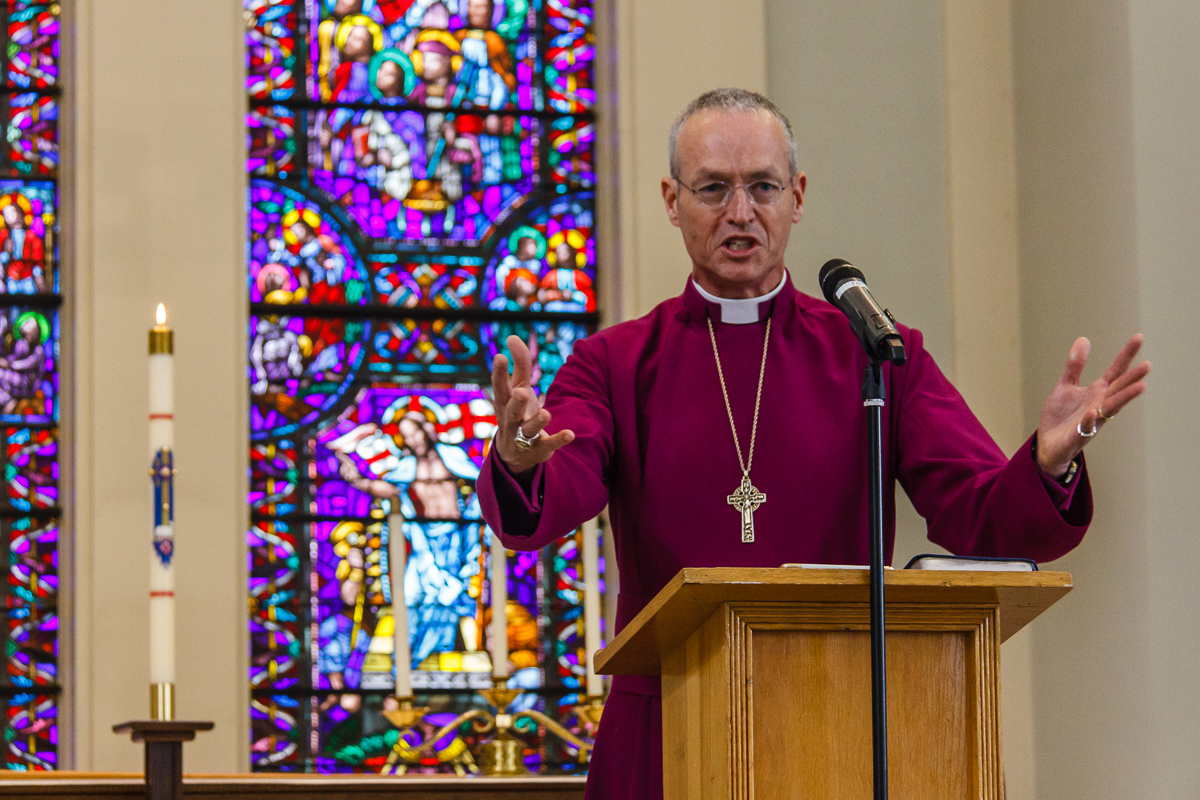
However, the word of God continues to speak into the circumstances of our world.  In the late 7th century B.C., God spoke through the prophecy of Habakkuk into a world which draws many comparisons to global circumstances which confront us at the dawn of 2016.

Look among the nations, and see;
wonder and be astounded.
For I am doing a work in your days
that you would not believe if told.   Habakkuk 1:5

 As the dawn breaks on a new year, consider these insights from Habakkuk chapter 1 verse 5.

1. Look at the ‘big picture’. History will be God’s story. If we only look at ourselves, at our nation, our people, our church, our denomination then we will miss what God is doing upon the face of the earth.

2. Look for a big surprise.  We so often limit God through our own thought processes.  We allow our culture and personal circumstances to be the filters through which we study the Bible.  In verse 5, God says Habakkuk will be astounded!

3. God will do something ‘in our lifetime’. In verse 5 God reassured Habakkuk that He will act and He will act during Habakkuk’s lifetime. Anyone can believe in God, what we must each decide is, do we believe that God will do what He says He will do in His Word?  If we believe that God will act according to His word, then we have faith in Him.


4. God can and will act in a manner beyond our imagination.  Habakkuk is told by God in verse 5 that He would not believe what God was about to do, even if God told him beforehand!  The apostle Paul writes in Ephesians chapter 3, “Now to him who is able to do far more abundantly than all that we ask or think, according to the power at work within us, to him be glory in the church and in Christ Jesus throughout all generations, forever and ever. Amen.”

5. God is already at work.  In verse 5, Habakkuk is told that God is already at work.  In verse 6, God describes how He has chosen to work and Habakkuk is surprised. From this we learn that God is at work to will and to act according to his purpose and not ours!  

In his 19th century hymn “God is working his purpose out” which was dedicated to the Archbishop of Canterbury and first published in the Hymn Book of the Church Missionary Society in 1899, author Arthur Campbell Ainger provides a clear testimony that God is the Lord of history, that he “is working his purposes out”  even when we cannot fathom his way.

May God’s eternal faithfulness encourage us to stand firm in the faith and be strong whatever circumstances we encounter throughout 2016 and beyond.

God and Father of our Lord Jesus Christ,
whose years never fail and whose mercies are new each returning day:
let the radiance of your Spirit renew our lives,
warming our hearts and giving light to our minds;
that we may pass the coming year
in joyful obedience and firm faith;
through him who is the beginning and the end, your Son, Christ our Lord,
who is alive and reigns with you,
in the unity of the Holy Spirit,
one God, now and for ever.
Amen.

The Anglican Way

by  (Dr. Gerald Bray is research professor for Beeson Divinity School in Birmingham, Alabama).

The English Reformation produced the Book of Common Prayer and the Thirty-nine Articles of Religion as its foundational documents. Both represent the more Reformed (as opposed to Lutheran) phase of the English reformation, though they are closer to patristic and medieval traditions than most Reformed documents are.

Archbishop Cranmer believed that he had to reform the worship, doctrine, and discipline of the church. The Prayer Book represents reformed worship, and the Articles contain reformed doctrine. Yet Cranmer’s reformed discipline failed to gain parliamentary approval, and that failure was a factor that led to the rise of puritanism.

The first Book of Common Prayer appeared in 1549. It contained services for daily worship, both morning and evening, and forms for the administration of baptism and the Lord’s Supper, along with other ceremonies that were used less often. The services were full of biblical phrases and imagery, and English people absorbed a considerable knowledge of Scripture from the Prayer Book, which was often repeated and easily memorized. The most important service was the one for the Lord’s Supper. Cranmer used traditional medieval English liturgies like the Sarum rite (“Sarum” is Latin for the town of Salisbury, in southern England), a liturgy drawn from Norman, Anglo-Saxon, and Roman traditions in the eleventh century. Cranmer restructured the old liturgies, however, in order to bring out the centrality of justification by faith alone. The communicant’s attention was directed away from the consecration of the bread and wine, which recalled the Roman Catholic doctrine of transubstantiation, and refocused on his spiritual state, in line with Reformed teaching.

In order to reach the widest audience with the least resistance, Cranmer was careful not to break too obviously with tradition, and although the doctrines of the Reformers were clearly stated in the Prayer Book, traditionalist Catholics could still use the new rites. Cranmer had to move on, and in 1552, with some help from Martin Bucer and John Knox, he brought out a much more radically Protestant Prayer Book. What this meant can be seen in the revision of the words used in the administration of Holy Communion. In 1549, the minister said: “The body of our Lord Jesus Christ which was given for thee preserve thy body and soul unto everlasting life.” This did not make it clear whether the bread being given to the recipient was transubstantiated or not. But in 1552 the words were changed to: “Take and eat this in remembrance that Christ died for thee, and feed on him in thy heart by faith, with thanksgiving.” Here what the communicant received was bread, and he was told to reflect on the presence of Christ in his heart.

In 1559, the 1552 Prayer Book was brought back after Queen Mary banned it, with some modifications. In the example given above, both sentences were included, making the words of administration very long. This was a concession to traditionalist sentiment, but it was Protestantism that predominated, and when the Prayer Book was revised again in 1662 this was reinforced. American readers need to realize that, although the 1662 Prayer Book is the classic Anglican form that is still used in England, it was replaced in the United States (in 1786) by a form that was closer to the 1549 book. As a result, the American Episcopalian liturgical tradition is more “catholic” and “high church” than its English counterpart.

Until the liturgical reforms of the mid-twentieth century, most Anglicans used the 1662 Prayer Book as a matter of course. Its language and its doctrines penetrated deep into the psyches of the English-speaking peoples, and its power to win souls for Christ is widely attested. Charles Simeon, the great evangelical leader of the early nineteenth century, was converted by reading it in preparing himself to receive communion. The warnings against unworthy reception that the Prayer Book contains went straight to his heart. Simeon repented as the Prayer Book urged him to do, and he gave his life to Christ. In Africa and Asia today, the strength of the Anglican churches there is partly due to the translations of the 1662 Prayer Book, which do not sound archaic in the way that the original English version now does. Tragically, it seems that the current spiritual lethargy of Anglicanism in the English-speaking world is connected to the demise of the Prayer Book since the 1960s. However, there is still a faithful remnant that keeps its witness alive, both in the traditional 1662 form and in modern-language adaptations, and there are signs that a spiritual renewal may be developing that will influence the Anglican Communion in the next generation.

The Thirty-nine Articles are usually printed with the 1662 Prayer Book, but they have a different history. There were forty-two of them in 1552, when Archbishop Cranmer gave them to the church. A revision was made in 1559–63 by some of Cranmer’s disciples, and the number was reduced to thirty-nine, though this was not achieved simply by leaving three of the older articles out. They were rearranged, expanded in some places, and abridged in others, though it must be said that Cranmer’s articles on the millennium, originally designed to counter the Anabaptists, were omitted in the 1563 version. The Articles were given official status by King Charles I in 1628; since then they have been the accepted doctrinal standards of the Church of England. Other Anglican churches have received them to a greater or lesser degree, sometimes with revisions, as happened in the United States (1801). But not all Anglican churches recognize them, and it has to be said that most Anglicans today are scarcely aware of their existence. Even the clergy have seldom studied them, and only evangelicals now take them seriously as doctrine.

The Articles are not a comprehensive systematic theology in the way that the Westminster Confession is, but they do address questions of theological controversy in a systematic way. In that sense, they are more advanced than earlier Protestant doctrinal statements. They start with the doctrine of God, go on to list the canon of Scripture, and then get into more controversial subjects. Justification by faith alone is clearly stated, and there is also a clear defense of predestination. The sacraments are numbered as two only, and they are defined as witnesses to the Gospel. Towards the end there are articles defining the powers of the civil magistrate, along with one that sanctions the two books of Homilies, collections of sermons in which the doctrines of the Articles and Prayer Book are more fully expounded. The Homilies are almost unknown today, but they have recently been reprinted, and this may lead to a renewal of interest in them.

The Westminster divines realized that the Articles were products of their time and needed supplementing even in the mid-seventeenth century, and few voices would dissent from that judgment today. What the Articles say is fair enough, but they need to be developed further if their doctrine is going to be appreciated and used in the modern church. Whether this can be done in the current state of the Anglican Communion is doubtful, but the Articles remain a touchstone of Reformed Anglicans, and perhaps their brief and judicious statements will one day gain them greater acceptance within the wider Reformed community.

An Interview with Julian Dobbs by livingwithfaith.org

Barnabas Aid (USA) and Barnabas Fund (UK) stand at the forefront of the organizations seeking to aid persecuted Christians around the world.  Bishop Julian Dobbs, Barnabas Aid USA’s Honorary Director, kindly agreed to answer LivingWithFaith.org’s questions about the vital work this organization is striving to accomplish.

LWF:  Thank you for taking our questions, Bishop Dobbs.  We live in times of marked increase in the persecution of Christians in many areas around the world.  As this persecution rages globally, Barnabas’ resources must be strained to the limit.  How does your organization decide where and when to apply the resources it has available?2015-05-01-Canon EOS 60D-289-13

Dobbs:  Barnabas Aid has been working to support Christian minorities who are suffering for the faith for over 20 years.  Our strong base of local and proven Christian partners in regions experiencing suffering allows us to effectively provide support in times of urgent and ongoing need.  We endeavor to respond to crisis situations, such as the current plight of Christians in Syria and Iraq, as the needs develop, and we ask God’s faithful people in the West to support their brothers and sisters who are suffering.

LWF As early as 2013, you wrote an open letter to Barack Obama, President of the United States, calling for urgent intervention in support of the persecuted Christians in Syria. To what degree do you feel the US  and other leading nations have responded to this and other calls for action, and what more can be done by our nations regarding the human rights of threatened Christians worldwide?

Dobbs:  The Obama administration can be commended for recently announcing support for refugees from Syria, however they have resisted giving specific and designated support to Christians from the region who are suffering.  Some European governments have been willing to support suffering Christians by providing special visas specifically for Christians.  I continue to call upon the Obama administration to do the same.  Barnabas Aid’s ‘Operation Safe Havens’ is specifically focused to relocate persecuted Christians to countries that will welcome the faithful followers of Jesus Christ.

LWF: Barnabas Aid clearly utilizes a broad spectrum of tools to help the persecuted – ranging from legal and financial assistance to physical evacuation of believers from problem areas.  In what areas can Christians in our own culture help in this struggle, in addition to prayer and the giving of financial support as we are able?

Dobbs:  Prayer and financial support are always important as the needs are enormous and growing. Christians in the West can also petition their local and national representatives and call for support for the suffering Christian community.  Barnabas Aid currently has a petition asking governments to provide a specific immigration process to support Christian minorities.

LWFBarnabas’ “Operation Safe Havens,” which physically evacuates believers from areas of great danger, has been featured by several news media. To what extent are national governments in the Middle East and Africa, in particular, helping in the relocation of their threatened Christian communities? 

Dobbs:  There are significant numbers of internally displaced Christians in their countries of origin and increasing numbers among the throngs of refugees making their way across Europe.  To date, the Polish government has offered assistance and Barnabas Aid has begun resettling Christians.

LWFWe are seeing increasing numbers of suicide bombers attacking Christian churches in areas as distant as Nigeria and Pakistan.  Does Barnabas Aid advise Christian groups in affected areas on basic security issues or other preemptive responses to emerging problems?

Dobbs:  Our ministry is to support suffering Christians.  In many cases, church leaders in the local areas seek our guidance and support on a wide range of issues, however our primary role is to bring support from Christians, through Christians, to Christians.

LWF:  Concurrently, we are seeing an increasing drive for a Muslim only Middle East, a Hindu only India,  and other similar developments in other areas of the world.  Has the situation always been this bad, or are we seeing the result of factors specific to our time?

Dobbs:  There is certainly increased hostility and intensity directed towards Christian minorities.  From the very early days of Christianity, the followers of Jesus Christ have been under pressure when they have faithfully proclaimed the gospel in hostile environments.

LWF:  If we may ask a personal question, helping the persecuted is clearly only part of what you stress in your own calling.  The hurricane relief work you organized in Indonesia, for example, was recognized by the New Zealand government. How do you balance your commitment not only to the need you see among the many persecuted Christians in the world, but also to other areas of relief work where help is often so badly needed?  What is your advice to Christians who see the same manifold needs? 

Dobbs:  We pray for God’s wisdom and guidance, that He will lead us, provide through us and be glorified in our lives and ministries.

* LivingWithFaith.org  recommends Barnabas Aid’s website www.barnabasaid.org and the organization’s bimonthly magazine barnabasaid.

http://www.livingwithfaith.org/barnabas-aid-interview.html

The Sound of Silence

When a civilization falls in the fog of war, and no one pays attention, does it make a sound?

Article written by Mindy Belz | World Magazine

In August when ISIS militants destroyed the fifth-century Mar Elian monastery in Syria, the destruction of yet another landmark for the ancient Assyrian Church of the East was barely noted.

In their original homeland of Syria and Iraq, the Assyrian people themselves also are falling to the hammer blows of ISIS. A raid last February on Assyrian villages in northern Syria forced thousands to flee, and caught hundreds in captivity. At this writing, among those taken captive in those raids along the Khabur River, 227 Christians remain in captivity. Given what we know of the ISIS detention system, it’s likely the men have been executed and the women and girls herded into a slave system whose trademarks are forced marriages and repeated rapes.

Mar Elian is in Qaryatain, a modest oasis of a town in the middle of the Syrian desert between Homs and Palmyra. In the Old Testament it’s known as Hazar-enan. When ISIS militants took Qaryatain, they kidnapped another 260 Christians.

‘This administration will not issue visas for Syrians based on Christian faith.’

The fighters and suicide bombers, many of them Saudis and Tunisians, overwhelmed Syrian government forces, who responded with aerial assaults, including the now-infamous barrel bombs that brutally destroy property and lives. This is a repeat of what happened in the city of Homs starting in the earliest months of the 4-year-old war. Christians who escaped—I interviewed some of them in Lebanon—described pulling feathers from pillows to burn for small fires so they could boil weeds to eat.

For Christians and Muslims alike in Syria, these are days of desperation. The difference for the Christians is that whenever it is over, they will have no homes and no place to return to. Across Syria and Iraq, the ancient civilization set down in the Bible and throughout church history is being wiped out. Even church leaders there no longer counsel Christians to stay, realizing they have no hope to survive.

The United States is the largest home to Assyrians, many of them driven out starting a century ago during the Armenian genocide. Yet the Obama administration has made clear it won’t shelter the Assyrian refugees forced from Syria or Iraq by ISIS.

“This administration will not issue visas for Syrians based on Christian faith.”

That was the word given to Anglican bishop Julian Dobbs by the State Department’s Bureau of Population, Refugees, and Migration. As a board member of Barnabas Fund, one of the largest relief organizations working in Syria and Iraq, Bishop Dobbs appealed to the State Department earlier this summer on behalf of the Assyrian Christians. The State Department said no.

Officials told Dobbs the Assyrians should use “people traffickers” to get across their borders to Turkey then appeal to the UN for refugee status. When Dobbs pressed his case, reminding officials of the large Assyrian diaspora in the United States and the U.S. obligation (at least historically) to reunite families and people groups, the State Department response was emphatic: “We better hope the Brazilians can take them.”

In fact, new countries are emerging as safe havens: Poland, Czech Republic, and Brazil. The Polish government was the first to agree to grant visas for Assyrian Christians, and a 95-year-old Holocaust survivor is footing the bill to resettle them in Poland. Lord Weidenfeld, a Jewish member of Britain’s House of Lords, said he has “a debt to repay” Christians because Quakers and Plymouth Brethren fed, clothed, and housed him as he escaped Nazi-occupied Austria in 1938. The lack of concerted effort on their behalf from the American church is, well, startling.

To recap: The United States took sides in Syria’s civil war within weeks of its start in 2011. President Barack Obama told the world it was time for President Bashar al-Assad to go, “for the sake of the Syrian people.” Since that time U.S. taxpayers have provided $400 million in mostly nonlethal aid to rebels fighting the Assad regime and $3 billion in humanitarian aid. In the White House view, that’s enough to make it look as if we’re doing something without aggravating the anti-war left. From the Syrians’ viewpoint, it’s just enough to aggravate a grim war, to make Americans complicit in the demise of one of the oldest civilizations, and one renewed by the gospel of Jesus Christ starting in the first century.

The Bishop’s Pastoral Address May 1, 2015

The Bishop’s Pastoral Address

The Rt. Rev. Julian M. Dobbs L.TH, Th.M, D.D Missionary Bishop

Presented May 1, 2015 at the Diocesan Synod held in Wayne, Pennsylvania

In the name of God the Father, God the Son and God the Holy Spirit, Amen.

On a hillside just to the north of the Sea of Galilee, Jesus was teaching disciples about the Kingdom of God. Blessed are the poor in spirit, blessed are the meek, blessed are those
who hunger and thirst for righteousness sake. Blessed are the peacemakers, the pure in heart, the persecuted for righteousness sake. And then He said something even more astounding and incredible – Jesus commissions his disciples with a messianic title that He claimed for himself, “the light of the world”. Matthew chapter 5, verse 14, “You are the light [the fire]

1of the world. Let your light [your fire] radiate with brilliancy before others, so that they may see your good works and give glory to your Father who is in heaven.”

This powerful assignment from Jesus is the theme of our 2015 Synod, and yet, it is something much more significant than our theme. Our Lord’s commission to be the light of the world is being embraced by congregations, lay people and clergy across the Missionary Diocese of CANA East from Maine to Miami and from Tulsa Oklahoma to Virginia Beach.

Be the light of the world, in order that others may see your good works and give glory to your Father who is in heaven. [I will return to our Synod scripture before I conclude this pastoral address).

It is both an incredible privilege and honor for me to welcome The Most Rev. Dr. Benjamin Kwashi, the Bishop of Jos and the Archbishop of Jos Province, Church of Nigeria (Anglican Communion). The Anglican Province of Jos has been subjected to numerous horrific outbreaks of religious violence and acts of terrorism. Many thousands of Christians have been killed and numerous churches and associated buildings have been destroyed.

In 1987, Archbishops Kwashi’s church and vicarage were totally burned down in Christian- Muslim riots. He has survived three attempts on his life and speaks first hand of Almighty God’s grace and power experienced in the most difficult of situations.

Courage has come at a personal price for Archbishop Kwashi who has been personally targeted by Islamic extremists. His beautiful wife Gloria was badly beaten by Islamic extremists and dragged through the streets to the diocesan offices. She was left blind until surgery in Texas restored her sight. Almost 18 months later, as the family prepared to celebrate Gloria’s recovery, four young men arrived to kill Archbishop Kwashi, however the Lord rescued him and his family.

Archbishop Ben and his wife Gloria have six children. I have been a guest in their Jos home and privileged to minister in their diocese.

As the Anglican Church across the United States and Canada became increasingly unhinged from its biblical and historical theological moorings, God spoke to Archbishop Benjamin Kwashi about a vision for a new work, a new biblical mission where Anglicans would be ‘light to the world’ declaring and defending the gospel once for all entrusted to the saints.

Archbishop Kwashi’s vision would become in time the Convocation of Anglicans in North America.

Your Grace, The Missionary Diocese of CANA East exists today, in part, because of your vision for Anglican mission and ministry in North America. Thank you, Sir, for being a catalyst used by the Living God to establish the ministries represented in this gathering today.

Your Grace, on behalf of the delegates of the third Synod of the Missionary Diocese of CANA East, I welcome you among us. Brenda and I are honored to call you and Mama Gloria our friends. You are a modern day hero of the faith and one of the most courageous Christian leaders of our generation.

Thank you for responding to my invitation to gather together for this Synod of our Missionary Diocese. At our inaugural Synod three years ago, we began life as a diocese with 23 congregations and missions. Today, three years later, 31 congregations and missions call The Missionary Diocese of CANA East their jurisdictional home.
We remain one of four dioceses of the Convocation of Anglicans in North America and are full members of both The Anglican Church of North America and The Church of Nigeria (Anglican Communion).

During the past year, two beloved members of our clergy family have died. We remember with thanksgiving to God, The Rev. Gilbert Wilkes, III. There are many phrases attributed to Gil (some of them we must not mention in this setting) however, in an essay Gil wrote entitled, Death by Delay / A Failure of Fortitude, he said, “We have a problem, the time for delay and discussion is over, George Patton had good advice for those of us who claim Biblical Orthodoxy, “Lead, follow, or get the hell out of the way!” We also remember the untimely and tragic death of The Rev. Dr. Kent Hinkson, a much loved priest of our diocese and express our condolences, love and prayers to Mrs. Pam Wilkes and Mrs. Jeline Hinkson, their families and congregations.

A diocese is a family of Christians and congregations under the oversight of a bishop who voluntarily choose to belong to a synod. Though diverse in their service, the congregations of this diocese hold to a shared confession of the Christian faith as taught in Holy Scripture and the historic formularies of the Anglican Church.

When many people think Anglican, they think Westminster Abbey, Lambeth Palace, grand cathedrals and local churches with high steeples and domes designed by such well known architects as Sir Christopher Wren. Sometimes we even make journeys to these Cathedrals of England and Europe, perhaps in an attempt to secure within us our Anglican heritage.

And yet, we in CANA East find ourselves in a missionary diocese. Our diocese was inaugurated in a rented chapel in the mountains of Ridgecrest, North Carolina in 2012 and our diocesan headquarters are in a shared facility with another Christian organizations in Virginia. Our pastors and lay leaders are missionaries. Our congregations are centers of missional activity and outreach. Sunday by Sunday the faithful congregations of CANA East are meeting for worship in missional contexts.

Holy Cross in Virginia Beach, Virginia meets each Sunday morning in a storefront.

St. Thomas’ in Springfield, Missouri meets week by week in the East Richmond Place home of Archdeacon Carl and Janet Eyberg.

Redeemer Church in Annapolis, Maryland meets at the Lowes Annapolis Hotel and from time to time in a photographers studio. Church of the Pentecost in Harrisburg, Pennsylvania, a congregation that was inaugurated less than two weeks ago and was officially received as a congregation of the diocese this morning, meets for worship at the Maple Street Fire House, complete with fire trucks and sirens… …[seems a most appropriate location for a church named after the outpouring of God the Holy Spirit on the Day of Pentecost]! Numerous congregations of the diocese meet in rented facilities, some share space with other churches, while others have been able to make the transition to more permanent locations.

This reality keeps us anchored in the missional commission from our Lord to be ‘light to the world’. Cathedral steeples, grand organs and elevated pulpits are not wrong, they are tremendous gifts to be used for the glory of God. However, our current expression of Anglicanism is somewhat different. As your bishop, I truly believe that Almighty God has called The Missionary Diocese of CANA East as a biblically reshaped mission seeking to reach North America with the transforming love of God. The Lord of the Church has given us a holy opportunity to re-examine our mission, our ministry, our structures and our national and global relationships, to fully engage in God’s call upon our lives. As a result, the optics of our mission may look different from traditional Anglican structures.

The ministry to which Christ has called us, presents us with a considerable challenge. Will we together as Anglicans in this Missionary Diocese, forgetting what is behind and straining forward to what awaits us, embrace the difficult challenge of our Lord, rise up and embrace the opportunities that are before us, or will we be more content to replicate the patterns and structures of our former days?

It was not long after their deliverance from the Egyptian oppressors that the children of Israel began to whine and complain about their circumstances. “We remember the fish we ate in Egypt that cost nothing, the cucumbers, the melons, the leeks, the onions, and the garlic. But now our strength is dried up, and there is nothing at all but this manna to look at.” I want to prayerfully and carefully remind us as a Missionary Diocese that we must not be complacent or overwhelmed and reinvent the less effective structures of the past. We remember the buildings, the trust fund money from dead people, the financial resources and legacies of the diocese, the choir vestments and the silver chalices donated by founding church families. We remember full time clergy salaries, annual stipend increases, retirement funds, renovated rectories, clergy discretionary funds and Synod’s that were in easy driving distance from our homes. We must be constantly vigilant against an all-too-human temptation to feel that the past was better, easier and so much less stressful.

If you are ever tempted to think the past was better, consider the present just for a moment. In the three years since the inauguration of this diocese 14 people have been ordained into holy orders (five more will be ordained at our service tomorrow). Nine new Anglican churches have been planted (including our host congregation here in Wayne).

St. Andrew’s in Endicott, New York, Church of Transformation in Mays Landing, New Jersey, Good Shepherd in Binghamton, New York, Holy Trinity in Plainville, Connecticut and Holy Trinity in Syracuse, New York all have new buildings of their own, some with no debt at all, some gifts from other congregations, all a result of the incredible provision of the Lord of the Church.

If you are ever tempted to think the past was better, consider for a moment the incredible clergy of this diocese.
They truly are incredible because they believe the call of God on their lives is a holy calling. This Missionary Diocese has been blessed by God with an extraordinary House of Clergy. Ordained men and women who believe that faithfulness to the gospel is greater than climbing the ecclesiastical ladder, or the increasing status of their 403b retirement plan.

Clergy who believe that proclaiming the Word of God and celebrating the sacraments is their highest calling, even if such proclamation is considered unpopular and archaic. Clergy who believe that serving the people entrusted to their pastoral care may even require them to have additional employment, to serve bi-vocationally as pastors and church planters.

In addition to preaching the Word of God, visiting the sick, serving the poor, burying the dead, leading church worship, raising money, responding to bishops:

Archdeacon Patrick Malone, Vicar of Holy Cross Anglican Church in New Berlin, Wisconsin leaves every week day morning at 6am and again at 2pm to drive public school buses so that his family are provided for and the growing congregation has ordained leadership.

While leading All Saints’ Anglican Church in Newark, New Jersey and serving as Archdeacon and advisor to the Bishop, the Venerable Dr. Paul Ekezie is employed as a geologist for the City of New York’s Department of Design and Construction.

While being the father of a ‘not yet 12 month old’ first child and the Vicar of Christ Church Anglican in Branford, Connecticut, The Rev. Matthew Mahan works 25 hours per seek as a department head for Hobby Lobby, in order to fulfill his calling as the leader of the congregation.

Church planter Canon-elect Augustine Unuigbe from Church of Transformation in Mays Landing, New Jersey, father of three, works nights as a medical doctor from 6.00pm to 6.00am, his wife Florence, also a doctor works days from 6.00am to 6.00pm. When Bishop Bena visited two weeks ago they had 30 people in attendance and took an offering of $654 for the diocese.

The Venerable Dr. Wayne Buchanan, Rector of St. Brendan’s in Tremont, Maine, Archdeacon of the North East, advisor and international travelling companion to the Bishop drives a 110 mile round trip twice a week to lecture in biblical studies and languages at Grace Evangelical College & Seminary.

Consider not only our clergy but also the often unspoken, un-thanked sacrificial service of our clergy spouses.

While balancing the very godly calling of motherhood and demands of being married to clergy (most of whom are ‘Type A’ personalities) many clergy spouses in this diocese have secured regular employment to enable their husbands to serve as rectors of our congregations.

Thank you clergy and spouses. Thank you on behalf of the Missionary Diocese of CANA East. You have been called to a life of dedicated sacrifice. To leave the palaces behind and follow Almighty God – through desert, swamp, mountains and across the wide rivers. To stand firm against the scoffers and the enemy. Your service is recognized, it is acknowledge and may Almighty God be thanked and praised of each of you.

And so, while the last twilight beams of our former jurisdiction might be a nostalgic memory of patterns, structures and financial certainty, consider what God is doing among us today. Today, He is clearly at work building His Church as He said He would, this should encourage and strengthen us in our mission!

Bishop John Jewell, 16th century Anglican English Reformer and Protestant Apologist, Anglican Bishop of Salisbury wrote, “Let us consider how mercifully God hath dealt with us. He hath restored unto us the light of his gospel, and hath taught us the secrets of his heavenly will. We hear him talk with us familiarly in the Scriptures, as a father talketh with his child. Thereby he kindleth our faith, and strengtheneth our hope; thereby our hearts receive joy and comfort.”

Three years ago, I presented to you what I believe to be the priorities of our mission together. When I presented my vision for this new missionary diocese at the 2012 Catalyst meeting held at Bishop Seabury Anglican Church, I announced eight focus areas that I believed the Lord laid upon my heart after prayer, consultation and planning. These eight areas of mission can be found in the online pamphlet entitled – “Come Let Us Arise and Build – a bishop’s vision for a missionary diocese.”

Last year as we gathered for our second Synod, I emphasized ‘Church Planting’ by asking each of our congregations to very prayerfully and intentionally consider planting one new congregation within the next three years.

How encouraging it was to hear that:

The Venerable Dr. Paul Ekezie is seriously planning a new church plant out of All Saints’ in Newark, New Jersey.

In his retirement, The Rev. Donald Helmandollar is considering planting in Rhode Island.

Church of the Pentecost, Church of Transformation, Reformation Anglican Church are all new church plants [and there are other conversations happening about church planting across the diocese].

Over the past year, a number of people have said to me, ‘We are not ready bishop, our current congregation is too small.’ You and your congregation are the best equipped to know when the timing and resources are right to plant, however the ‘too small’ argument is never a winner with me! Brenda and I, our then 18 month old son Samuel, and two additional couples planted Bishopdale Community Anglican Church, which by the grace of God became the fastest growing Anglican congregation in that location at that time.

Church planting is an achievable goal for most of our congregations. I strongly encourage and urge you to prayerfully prioritize church planting in your congregational planning this coming year.

I also spoke about ‘New Leadership’, recruiting, training and developing new clergy in our diocese. It has been significantly rewarding for me as your bishop to watch many of our congregations embrace this vision.

Christ the King Anglican Church in Pine Knot, Kentucky with a membership of 21 individuals is the sending congregation of Lucas Waters, a seminarian from this diocese at Trinity School for Ministry.

The Rev. Briane Turley, Rector of Church of The Holy Spirit in Tulsa, Oklahoma has brought 23 year old Seth Whitaker to this Synod, a young man clearly called by Almighty God into His service.

The Venerable Alan Crippen II is preparing post graduate Christian leaders for ministry in the public square through his ministry at the John Jay Institute where Roman Catholic students, Baptist students, Quaker Students, Non Denominational Students use they daily office of the 1928 Book of Common prayer in their formation as leaders.

Joel and Christy Lafferty are with us at this Synod. A young couple who believe that God is calling them to serve as missionaries abroad.

The Rev. Adam Rick is engaging with students at Eastern University in a weekly bible study, two of whom will be confirmed in this church on Sunday afternoon.

The Venerable Patrick Malone is assisting to train Deacon Lawrence McElrath who will serve as a chaplain in the United States Military [and there are many others].

As your Bishop, I firmly believe that educating and ‘unleashing’ the spiritual power, enthusiasm and entrepreneurial creativity of newly recruited and younger clergy is one of my highest priorities.

As we consider our Lord’s commission to be ‘the light of the world’ I believe the Lord is calling us to be a diocese that Confronts And Transforms Injustice Through Serving Our Community And Nation (this is a third focus area of my vision for a Missionary Diocese).

With foundations in the 16th century English reformation, Anglicans have been among the champions of numerous global movements that continue to be at the forefront of transforming unjust structures: William Wilberforce: Christian Abolitionist, Reformer, Statesman; Florence Nightingale, Nurse, Social Reformer. In our own nation, George Washington, John Jay, James Madison, all Anglicans who have impacted their own immediate situations and

influenced global movements from the rise of democracy and the rule of law, to religious freedom, human rights, and the abolition of slavery.

At this Synod we will hear from Church of the Good Shepherd in Binghamton, New York, Glory of God in Cocoa, Florida, St. Brendan’s in Tremont, Maine and Church of the Holy Spirit in Tulsa, Oklahoma who are fulfilling our Lord’s commission to be ‘the light of the world’ in very practical and effective ways.

Many congregations and individuals across the Missionary Diocese of CANA East are serving as a voice for the voiceless, ministering to those in our prisons, visiting and caring for those who are lost and lonely, for refugees and immigrants.

As your bishop, I invite each of the congregations and members of this wonderful Missionary Diocese to pray and plan to be the voice of Christ and the hands of Christ in our communities and across our nation. Pack food at your local community pantry, train as a hospice volunteer, serve at your local emergency-housing center.

As Fanny Crosby said in her famous 19th century hymn:

Rescue the perishing, care for the dying, snatch them in pity from sin and the grave; weep o’er the erring one, lift up the fallen, tell them of Jesus, the mighty to save.

What does the Lord require of us but to do justice, and to love kindness, and to walk humbly with your God.

Before I turn for a few moments to our Synod Scripture I want to acknowledge some faithful servants of Christ in our diocese.

Almighty God has blessed CANA East with lay leaders and clergy who serve well above and beyond the call of duty, our Standing Committee, Diocesan Secretary, Canons Missioner, our six Regional Archdeacons and many others are just a few of the faithful whose ministry is The Missionary Diocese of CANA East.

Alongside running his busy law practice in Syracuse, New York our Chancellor, Mr. Raymond Dague, offers legal advice to clergy and congregations of our diocese in matters relating to mission and ministry. There have been numerous occasions when my first SMS
of the day between 5.30am – 6.00am has come from our Chancellor who has already been hard at work that morning on legal matters requiring his attention in our diocese. However, there have also been occasions when I have woken our chancellor for advice while travelling internationally in different time zones. Raymond, on behalf of this diocese we honor you Sir, and thank you for your invaluable advice and servants heart in the mission we share in this diocese.

Earlier this year at a bishops meeting of the Anglican Church in North America, The Archbishop asked for a ‘show of hands’ from the bishops who might retire in 5 – 7 years. Out of the corner of my eye, I noticed the hand of Bishop David Bena begin to move heavenwards. In a response of astonishment from the opposite side of the room, I called out to our assisting bishop, “Put you hand down David Bena,” and if I recall correctly, Bishop Bena lowered his hand.

There are no words to express the gratitude of this diocese and my personal gratitude for the faithful, exceptional and outstanding service of Bishop Dave and Mary Ellen Bena. Bishop Bena even walks my two 70 pound boxer dogs and is my official marathon running coach. The only way to adequately thank them both is to say, “Thank you Jesus! Thank you Jesus! Thank you Jesus!”

My Executive Team, Canon-elect Neal Brown who serves faithfully as our Executive Canon, without any remuneration can only be described as a gift from heaven. Neal, may God be praised for your service to this Missionary diocese. Mr. William Reynolds our financial administrator and Miss Moriya French who serves as assistant to Brenda and me are genuine gifts from God who serve willingly and faithfully. Thank you for the gift of your partnership in the leadership of this wonderful diocese.

My ministry as your bishop does not stand on its own. By now, most you have come to realize that my greatest gift is not preaching or teaching, leadership, raising money or speaking to media. My greatest gift is she, who for the past 24 years has preferred the background rather the foreground. Proverbs says, He who finds a wife finds a good thing and obtains favor from the Lord. My wife who loves me, prays for me, believes in me, corrects and forgives me, together with our family who are represented here today by our daughter Grace Elizabeth (of whom I am so proud) have helped shape me into the bishop that I am today. Brenda I love you. I thank God for you. I rejoice that in the remote West Coast of New Zealand’s South Island, the Lord brought you and me together in covenant love and marriage.

I wonder if you believe it is possible for a nation or society to be changed and to be made more pleasing to God? We all know that by the grace and power of God, we ourselves have been changed and we know the power of the gospel to change individual people. But can society be changed?

For a moment let us consider our nation. Our view of marriage and the family, our attitude to human life and its sanctity, including the unborn and the senile, the administration of justice, the education of our young people. Consider our treatment of the unemployed and of men, women and children who are trapped in the cycle of addiction, deprivation and poverty. Consider our nation’s record in human rights, ethnic minorities, stewardship of the natural environment. At the heart of every nation there lies an ideology, a set of values, meanings, inalienable rights.

Here is the question for the Missionary Diocese of Cana East: Is it possible for the values and standards of Jesus Christ to prevail in North America so that our national culture is recognizably Christian?

According to last month’s Pew Foundation entitled, “The Future of World Religions,” the religious profile of the world is rapidly changing. In the United States, Christians will decline from more than three-quarters of the population in 2010 to two-thirds in 2050. Judaism will no longer be the largest non-Christian religion. Muslims will be more numerous in the United States than people who identify as Jewish on the basis of religion. More globally, four out of every 10 Christians in the world will live in sub-Saharan Africa.

I believe it is the will and purpose of Jesus Christ to transform society through his transformed people.

Please open your bibles to Matthew chapter 5:13-16

You are the salt of the earth, but if salt has lost its taste, how shall its saltiness be restored? It is no longer good for anything except to be thrown out and trampled under people’s feet. “You are the light of the world. A city set on a hill cannot be hidden. Nor do people light a lamp and put it under a basket, but on a stand, and it gives light to all in the house. In the same way, let your light shine before others, so that they may see your good works and give glory to your Father who is in heaven.”

Salt and light. These are the biblical images that our Lord Jesus himself chose in order to indicate the influence his followers are to exert in society.

Not unlike many of the congregations in our diocese, the disciples of Jesus were small in number and yet, Jesus called them the light of the world, the salt of the earth, and the question is what did he mean?

1. Contrasting Communities (vs:13-16) Christians are radically different from non- Christians, in Matthew 5:13-16, there are two communities, the Christian and the non- Christian, the redeemed and the unredeemed, the regenerate and the unregenerate communities in radical contrast from each other.

On one hand, there is the world with all its sin, evil and tragedy – – a dark place, and yet, on the other hand, there are disciples of Jesus Christ who are to be the dark world’s light. Christians and the world are set opposite each other and are as different as light from darkness. The world, which is rather like decaying fish or rotting meat because of its social decay, and Christians, who are to be decaying society’s salt.

Almighty God is calling out a people for himself to be his own community, the new community, the Messianic community, the community of Jesus Christ and listen, the vocation of this new community, is to be holy.

Jesus calls his new community to be salt and light to society, to be radically different.

2. Penetrating Pilgrims (vs.16) Christians are to penetrate non-Christian society. We are called by Christ to be morally and spiritually distinct.
We are not a socially segregated people. Look at verse 16, Jesus said, “Let your light shine. Let it penetrate into the darkness. Do not light your lamp and put it under a bed or under a bucket or in a cupboard. No, when you light your lamp, set it on a lamp-stand, that it may give light to the house. Let the light shine, let it penetrate.”

Both light and salt are both penetrating commodities. And yet, the great Christian tragedy is that so many disciples of Jesus Christ stay in our dark little dens and in our elegant ecclesiastical saltcellars, instead of getting rubbed into the community. Brothers and sisters, this is Christ’s call to us.

Remember Jesus himself came into the world and that is where he sends us.

3. Influential Inhabitants (vs.16) Salt does not salt itself. It salts the environment in which it is placed. Light does not enlighten itself. It is given to light the community in which it is lit. Jesus said, “Let your light shine before others, so that they may see your good works.” Influential inhabitants.

Both salt and light are effective commodities and they both change the environment in which they are placed. If you put salt in meat or fish, bacterial decay is hindered. If you switch on the light, darkness is dispelled.

When we look at the prevailing trends in our nation we see social injustice, racial disadvantage, neglect of inner cities, the continuing evil of unemployment, violence on the streets, selfish covetous materialism, corruption in high places, the breakdown of marriage and the family, sexual promiscuity, the disregard for the sanctity of human life, the deliberate eradication of religious freedom.

Who is to blame for the deterioration of standards in society? The media? The Administration? The agenda of theological and social revisionists? Well, yes, in part!

Brothers and sisters of CANA East, if society is decaying, we the Christians are responsible!

If the house is dark at night, there is no wisdom in blaming the house for the darkness. The question to ask is where is the light? If the meat goes bad and becomes inedible, there is no wisdom in blaming the meat for its decay. The question to ask is, “Where is the salt?”

If society becomes corrupt, like a dark night or a stinking fish, there is no sense in blaming society for its corruption. This is what happens when human evil is unrestrained. The question to ask is, “Where is the Church? Where is the salt and the light of Jesus Christ? Why are not we dispelling the darkness and hindering the decay?”

Brothers and sisters, it is hypocritical of us to raise our eyebrows and shrug our shoulders and wring our hands and blame the government. Jesus told us to be the salt and the light of society.
If rottenness and darkness abound, we have to accept a measure of blame and with fresh determination be the salt and light our Lord is calling us to be.

History is full of examples of societal transformation when people encounter the gospel in practical ways.

The Rev. Georgette Forney (CANA deacon) is with us at this Synod representing Anglicans For Life. Through this remarkable ministry the unborn are being saved from cruel and barbaric extermination and life in North America is being preserved. CANA deacon The Rev. Bob Ragan leads Regeneration Ministries helping those caught in cycles of sexual or relational sin to find freedom. Mrs. Faith McDonnell from The Institute on Religion and Democracy is with us at this Synod. They seek to reform the Church’s role in public life, protect religious freedom, and support democracy at home and abroad.

How do we go about being light in what sometimes appears as the ever increasing darkness of social and political change. God in his loving mercy has given us tools for the task.

1. We Pray: Christian prayer is different from every other kind of prayer because at the center of Christian prayer is Jesus Christ. The New Testament urges Christians to pray for the nations and their leaders, that we may lead a quiet and peaceable life in all godliness – – this is the will of God.

2. We Evangelize: Evangelism has an indispensable place in social action. Christian social action is impossible without socially active Christians, and socially active Christians emerge out of evangelism. It is when people are born again by the Spirit of God that He gives them a tender social conscience. We have a gospel to proclaim that will transform society. We pray. We evangelize.

3. We Engage. Brenda and I live in the suburbs of our Nation’s Capital. I spend some of my days engaging Congressmen, Senators and Administration officials over gospel matters. Some of you are doing the same. Why? Because godly legislation can reduce evil in society and make it more pleasing to God. Martin Luther King said, “Morality cannot be legislated, but behavior can be regulated. Laws may not change the heart, but they can restrict the heartless.”

Brothers and sisters of the Missionary Diocese of CANA East, Jesus is still calling us to be the light of the world.

American author Robert Bellah was the Elliott Professor Emeritus of Sociology at the University of California at Berkeley. He said: “We should not underestimate the significance of the small group of people who have a new vision… the quality of a culture may be changed when two percent of its people have a new vision”.

Two percent! Two percent of Pensacola, Florida! Two percent of New York City!…
Two percent of Branford, Connecticut. Consider the impact you can have on your church. Consider the impact Christians can have on their community. Consider the impact we can have on our nation. Consider the impact Christians can have in the world!

Our concern as followers of Jesus Christ is neither with a religion called “Christianity,” a denomination called “Anglican,” nor with a culture called “Western,” but with a person, Jesus of Nazareth, the one and only God-man who lived a perfect life of love, died on the cross for our sins, bearing in his own person the condemnation that we deserve, was raised in triumph from the grave and is now alive, accessible and available to us through the Holy Spirit, the One who was and is and is to come!

Missionary Diocese of CANA East, only in Him can we become the world’s salt and light, sharing the good news with others, making an impact on society, and above everything else, seeking to bring honor and glory to his wonderful Name. Amen!

This is our mission!

In the name of God the Father, God the Son and God the Holy Spirit, Amen.

The Rt. Rev. Julian M. Dobbs L.TH, Th.M, D.D Missionary Bishop