
Author: bishopdobbs
Archbishop Ben Kwashi to speak at CANA East Synod (April 30 – May 2, 2015)
Archbishop Ben Kwashi, a well known as a preacher and evangelist throughout Nigeria, Africa, England and the United States will be speaking at the CANA East Synod, April 30-May 2, 2015 in Wayne, Pennsylvania.
Bishop Julian Dobbs describes him as, “One of the most importa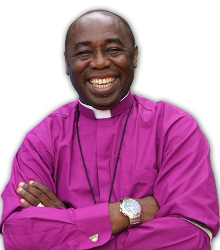 nt and courageous Christian leaders of our generation.”
Originally destined for a military career, in 1976 Archbishop Kwashi received a clear vocation to ordained ministry. He was ordained in 1982 and 10 years later became Bishop of Jos. In January 2008 he was presented as the Archbishop of Jos Province in the Church of Nigeria (Anglican Communion). He has worked in rural and urban churches, as a Polytechnic Chaplain, and at a Theological College. In 1987 his church and vicarage were totally burned down in Christian-Muslim riots. He and his wife Gloria have six children.
Archbishop Kwashi has survived three attempts on his life. He can speak first hand of God’s grace and power, experienced in the most difficult of situations. The province of Jos covers North Eastern Nigeria, which has had numerous outbreaks of religious violence where Christians have been targeted by Islamist militants. The Archbishop has been outspoken and openly critical of the press and the authorities whenever he has witnessed lies and injustice.
Such courage has come at a price, for Archbishop Kwashi who has been personally targeted and his wife, Gloria, and son have been badly beaten. On that occasion, Gloria was dragged through the streets to the diocesan offices. She was left blind until an operation in Texas restored her sight. Almost 18 months later, as the family prepared to celebrate Gloria’s recovery, four young men arrived to kill the Archbishop, who immediately fell to his knees to pray. “Man of God, we have come for you,” they said. “This is not the time for prayer.” They took him outside but stopped to negotiate the price of his life. One of them screamed. “I’ve changed my mind. Let’s take him back inside and kill him there.” It never happened. They took what money Gloria could find and disappeared into the night. That’s something of what contending for the faith has meant for Ben and Gloria Kwashi.
CANA East is one of four missionary dioceses in the Convocation of Anglicans in North America. Home to 31 congregations and almost 70 ordained clergy, CANA East is committed to planting and building biblical missionary Anglican churches across North America.
All are welcome to attend Synod and meet Archbishop Kwashi.
The Resurrection of Our Lord | April 2015
Come and see… Now go and tell
“Do not be alarmed. You seek Jesus of Nazareth, who was crucified. He has risen; he is not here. See the place where they laid him. But go, tell his disciples and Peter that he is going before you to Galilee. There you will see him, just as he told you.” Mark chapter 16 verses 6-8
In Mark’s gospel, two women both named Mary, visit the garden tomb on the first Resurrection Sunday morning. They find the stone which had sealed the tomb already rolled away, they encounter an angelic messenger who speaks to them about the risen Messiah and they see with their own eyes the tomb of Jesus is empty. And yet, we are told in verse 8…”they went out and fled from the tomb, for trembling and astonishment had seized them, and they said nothing to anyone, for they were afraid.”
The angel said to them, “Come and see, now go and tell.”
This is the Christian gospel in a sentence: come and see for yourself and now go and tell someone else about it.
In the longer ending of Mark’s gospel, Jesus commissioned the disciples to go into the whole world, preach everywhere, believe and baptize. Life and death is at stake because if someone does not believe in the risen Christ, they are lost. And so, obeying the commission of the risen Lord, the disciples go out with a pile of evidence, with hearts full of experience and the risen Lord Jesus went with them everywhere they went.
Just as the risen Lord was with them, so too He is with us who believe. May the evidence of the rolled stone, the empty tomb, the heavenly angel, the testimony of the disciples, give way to an experience with the risen Christ, that we too may “Come and see and go and tell.”
Christ is Risen… He is Risen Indeed!
+Julian
Easter, 2015
Bishop Dobbs Pastoral Address to the CANA Council 2015
Presented March 20, 2015 at the Annual CANA Council held in McLean, Virginia.
In the name of God the Father, God the Son and God the Holy Spirit. Amen
I welcome each of you to this annual Council meeting of the Convocation of Anglicans in North America. I am thankful for each one of you and the considerable investment of leadership, time and finance that is indicated by your attendance at this meeting over the coming days.
I am especially grateful for the presence of the Most Rev. Michael Akinyemi, Archbishop of the Ecclesiastical Province of Kwara and The Most Rev. Ignatius Kattey, Archbishop of the Ecclesiastical Province of Niger Delta. Your Graces’, you are very welcome among us. You honor us in CANA with your attendance at this year’s council meeting. Your presence among us signifies the foundational relationship that continues to be secure and strong between the Church of Nigeria (Anglican Communion) and the Convocation of Anglicans in North America. I will say more about the relationship between the Church of Nigeria and CANA later in this address.
As your Missionary Bishop, it is my responsibility to present this pastoral address to our Convocation. In this address I will talk about our life together as a Convocation, our relationships with the Church of Nigeria (Anglican Communion) and the Anglican Church in North America and we will study the Council Scripture from Philippians chapter 3.
2015 is a very significant year for our Convocation. On August 2nd, 2005 CANA was legally incorporated in the State of Texas. This year marks the tenth anniversary of our official incorporation as an Anglican missionary jurisdiction in North America. CANA began with a handful of faithful and courageous ex-patriot Nigerian congregations who were desirous of maintaining a direct relationship with the Church of Nigeria (Anglican Communion) amidst the turbulent theological revisionism that was reshaping the Anglican Church in the United States and Canada. Very soon after our founding it became clear that CANA was considered a very desirable jurisdiction not only for ex-patriot Nigeria clergy and congregations but many North American clergy and congregations who upheld historic biblical Anglican Christianity.
At the time, the response of the established hierarchy in New York and London was that our actions were ‘unhelpful’ and violate historic Anglican polity.
As recently as last month, when I was visiting the United Kingdom, I was asked if a jurisdiction of the Church of Nigeria within the boundaries of another Province in North America could be considered as Anglican?
So let us pause and consider exactly what it means to be Anglican. The Church of England states, “The Scriptures and the Gospels, the Apostolic Church and the early Church Fathers, are the foundation of Anglican faith and worship.”[1]
Furthermore it is stated that Anglicans profess the faith that is uniquely revealed in the Bible and set forth in the Catholic Creeds (the statements of faith developed in the Early Church that are still used in the Church’s worship today).
Anglicans also bear witness to Christian truth in historic texts that were developed in the sixteenth and seventeenth centuries: the Thirty-nine Articles of Religion, the Book of Common Prayer and the Ordinal (services for ordaining bishops, priests and deacons).
When these fundamental beliefs and foundations are revised and under assault, the Church must respond. So called ‘violations of Anglican polity’ must never be our priority, however when the gospel message of our Lord Jesus Christ is assaulted, Biblical theology must always trump organizational unity. Our priority must always be Christ and the gospel ‘once for all entrusted to the saints.’[2]
It was Hugh Latimer, one of the three Oxford Anglican martyrs who said in a sermon, “Unity must be according to God’s holy word… we ought never to regard unity so much that we forsake God’s word for her sake.” [3]
In what my friend The Rev. Ian McNaughton calls in his commentary on John chapter 17 “The Real Lord’s Prayer,” Jesus does not pray for cheap or superficial unity. He prays that the church may be organically unified to the Father and the Son sharing the divine life, reflecting and embodying the very unity which Jesus has with the Father.
So, if our proclamation of the gospel and our structural organization as a missionary jurisdiction in North America is ‘not quite cricket’ as the ‘Brits’ like to say, so be it, for the sake of Christ and His Kingdom
In his inaugural address to the first Council of the Convocation of Anglicans in North America, founding Missionary Bishop, The Rt. Rev. Martyn Minns said,
CANA is excited about the future. We have good news of great joy for those who live in the darkness of a post-modern world that has few answers and many questions. We believe that we have a message of hope for those who live in fear and the promise of new life for those who have lost their way. CANA is not primarily concerned about DOING church but about BEING church.
CANA was missionary then and she is missionary now. As a Convocation we exist not only as a jurisdiction for the 120 congregations and 450 clergy and chaplains who serve as members of our Convocation, we exist as a missionary movement called by Almighty God to replant biblical missionary Anglican Christianity across North America. This is the mission to which we in CANA have all been called by Almighty God.
Perhaps now, more than any other time in the history of North America we must zealously pursue our missionary mandate to make disciples of Jesus Christ.
An op-ed written in a January 2015 edition of the L A Times said, “More children are “growing up godless” than at any other time in our nation’s history. They are the offspring of an expanding secular population that includes a relatively new and burgeoning category of Americans called the “Nones,” so nicknamed because they identified themselves as believing in “nothing in particular.”[4]
The author was in fact celebrating this trend and the secularization of American society. He stated that 30% of Americans between the ages of 18 and 29 are without any religion at all.
Brothers and sisters in Christ, these concerning and disturbing statistics are not obstacles that prevent us from impacting our society with the love of God, they are in fact tremendous mission opportunities to teach and share the gospel message, to uphold the sanctity of every human life, to engage our nation in discussion and teaching about the value, impact and history of biblical marriage and family life.
From its founding until this very moment, we in the Convocation of Anglicans in North America know that without Him we are nothing, but with Him there are no challenges or obstacles that we cannot overcome.
No, in all these things we are more than conquerors through him who loved us. For I am convinced that neither death nor life, neither angels nor demons, neither the present nor the future, nor any powers, neither height nor depth, nor anything else in all creation, will be able to separate us from the love of God that is in Christ Jesus our Lord. (Romans 8:37-39)
CANA’s ministry is greatly impacted and strengthened by its bishops, dioceses and ministries.
The Jurisdiction of the Armed Forces and Chaplaincy, under the oversight of The Rt. Rev. Derek Jones supports the endorsement and care of chaplains under the oversight of the Bishop of the Armed Forces and Chaplaincy serving in the US military, federal and local government, hospital and hospice, law enforcement and other vocational and volunteer chaplains serving their communities. ‘Anglican Chaplains’ is a remarkable ministry. In June 2014, Mama Cana and I had the privilege of supporting Bishop Jones at his installation as the diocesan bishop of this special jurisdiction. We are very proud and honored that the jurisdiction remains an important part of our Convocation and Bishop Jones a full and active part of our shared life together.
The Missionary Diocese of CANA West, under the leadership of The Rt. Rev. Felix Orji, the diocese believes that the Church is the place where people come to worship God in Spirit and Truth, get converted through penitent faith in Christ as Savior, experience true saving and sanctifying grace through the gospel, feed from the Bible, learn humility, fellowship, love, obedience and faithfulness, be empowered by the Holy Spirit and equipped to live like disciples and followers of Christ who go out and make more disciples for Christ to the glory of God the Father.
Bishop Orji is a very active voice in our life together and his leadership is highly respected in our Convocation.
The Missionary Diocese of the Trinity, under the leadership of The Rt. Rev. Amos Fagbamiye is a Diocese composed of believers united by a common faith in the Lord Jesus Christ. United by a commitment to be Christ centered and all inclusive, serving a multicultural and multiracial community of faith. MDT is a full fledged ecclesiastical unit that operates as a missionary, evangelical and church planting mission and movement as a non-geographical cluster of churches and congregations in North America and Canada. I am very thankful to God for Bishop Fagbamiye and his leadership of the diocese and very much look forward to being in Indianapolis in July for the synod of the MDT.
In addition to my ministry as your Missionary Bishop, I also have the deep privilege of serving as the Bishop of the Missionary Diocese of CANA East. The diocese stretches from Maine to Miami and from Tulsa to The Bronx. Headquartered here in McLean, Virginia — we are home to 31 congregations and over 65 parochial and non-parochial clergy.
In addition to the diocesan bishops, CANA is blessed by God to be served by Bishop Dave and Mary Ellen Bena in Virginia, Bishop David and Mary Ann Anderson in Georgia, Bishop Roger and Gretsie Ames in Ohio and Bishop Martyn and Angela Minns in Florida.
I commend our CANA bishops to your personal and public prayers. These faithful men, their wives and families often find themselves on the front line of intense spiritual pressure. Pray that Almighty God would protect them and their familes, provide for them, empower them and use their lives for His glory alone.
CANA – The Church of Nigeria [Anglican Communion]
The Church of Nigeria [Anglican Communion] established CANA as a Holy Spirit-filled, gospel-centered, apostolically commanded, incredible gift to rebuild and replant biblical Anglicanism in North America.
At this juncture I wish to acknowledge the outstanding leadership of our Primate, The Most Rev. Nicholas D. Okoh. Archbishop Okoh takes a genuine and personal interest in the life and ministry of our Convocation. In August last year, the Primate made his Primatial visit to CANA and spent time in Houston, Texas, here at the CANA Headquarters in Virginia, in Newark, New Jersey and then in Vancouver, Canada.
He held very informative and instructive meetings with the CANA bishops here in our offices and participated in the life of CANA across North America.
I describe the relationship between the Church of Nigeria (Anglican Communion) and CANA by the following five explanations: Christ centered, legally established, missionally empowered, mutually affirming and unimpeachably Anglican.
Christ Centered: The Church of Nigeria (Anglican Communion) and CANA express our loyalty as disciples to the King of kings, the Lord Jesus.
Legally Established: The Church of Nigeria (Anglican Communion) legally amended its Constitution and Canons to accommodate for missionary convocations outside the geographical boundaries of Nigeria.
Missionally Empowered: The Church of Nigeria seeks to empower the bishops, clergy and congregations of CANA to develop biblical, evangelical and growing ministries.
Mutually Affirming: Both the Church of Nigeria and CANA benefit from the Christ centered interconnection which is the foundation of the relationship.
Unimpeachably Anglican: The Church of Nigeria and the Convocation of Anglicans in North America maintain the historic Faith, doctrine, sacrament and discipline of the one holy, catholic, and apostolic Church as the Lord has commanded in His holy word and as the same are received as taught in the Book of Common Prayer and the ordinal of 1662 and in the Thirty-Nine Article of Religion. The relationship provides CANA bishops, clergy and congregations with canonical residence in the Church of Nigeria (Anglican Communion) with the same status as bishops, clergy and congregations from within Nigeria.
As many of you will be aware, Nigeria as a nation is facing challenges on numerous fronts. Politically, the general election which has now been delayed until March 28, has caused some unrest and tension across the country. Religious tension has reached unprecedented levels with jihadi terrorist group Boko Haram declaring allegiance with the Islamic State. Although Nigeria was able to tackle the Ebola crisis much more effectively than other African countries, it remains stricken by the insurgency of Boko Haram in the north east of the country, a crisis which is proving to be even more deadly than the killer disease. More people have been killed in Nigeria by Boko Haram than have died in the entire Ebola epidemic, and the bloodletting seems to be only getting worse. Over 10,000 people have been murdered at the hands of Boko Haram in the last year alone. Many of our Anglican bishops and congregations have been affected. In a courageous display of tenacious and defiant faith, the Archbishop of Maiduguri told me last month that when the bombs explode in Maiduguri, the Christians have determined not to flee, but to gather in their churches and pray.
I am very thankful to The Lord for the godly and strong relationship between the Church of Nigeria (Anglican Communion) and the Convocation of Anglicans in North America. As your Missionary Bishop, I indicate to this Council, that although we may come under pressure to dissolve or change the status of the current relationship with the Church of Nigeria, the relationship is secure, it is highly valued by the CANA bishops and is the foundation of our affinity together in the mission to which Christ has called us.
I support introducing a motion during our business session calling upon this Council to express its support for the continued relationship that exists between The Church of Nigeria (Anglican Communion) and the Convocation of Anglicans in North America and in addition expressing this council’s serious concerns and prayerful engagement on behalf of Christians in Nigeria and everyone whose life and livelihood have been or are being devastated by the attacks of Boko Haram.
The Anglican Church in North America
In addition to the jurisdictional structure with the Church of Nigeria (Anglican Communion), CANA is a founding jurisdiction and full member of the Anglican Church in North America.
As such, the CANA bishops serve as bishops of the Anglican Church in North America and CANA dioceses, congregations and clergy are members of the Anglican Church in North America.
This the first CANA Council to meet since the election of The Most Rev. Dr. Foley Beach as Archbishop and Primate of The Anglican Church of North America and I warmly welcome a motion that will be introduced at our business session expressing goodwill and support for Archbishop Beach and the mission and ministry of the Anglican Church in North America.
While the Anglican Church of North America is not currently an officially recognized province of the Anglican Communion, the Church of Nigeria was the first province to formally and unanimously recognize the Anglican Church in North America. Both provinces enjoy full communion with one another through common membership in the Global Anglican Future Conference (GAFCON).
The Anglican Church in North America canonically provides for both affinity jurisdictions (dioceses) and regional jurisdictions (dioceses). Article IV Part II of the Constitution of The Anglican Church in North America says, “Congregations and clergy are related together in a diocese or network (whether regional or affinity-based), united by a bishop.”[5]
There has been considerable recent discussion in The Anglican Church in North America about the challenges of multiple overlapping dioceses and jurisdictions. Archbishop Beach has asked me to serve as a member of the Anglican Unity Task Force, which is considering this matter. I am less anxious about the multiple jurisdictions in The Anglican Church in North America because I firmly believe that to be effective gospel missionaries in the 21st century we must move from territory-centered structures to missional and relational structures. This requires us to build Christ-centered relationships with one another, to think ‘outside the box’ and to do whatever it takes to replant and rebuild biblical missionary Anglican churches across North America that faithfully proclaim the gospel and see numerous people converted to faith in Christ.
The relationship between The Church of Nigeria (Anglican Communion), The Anglican Church in North America and the Convocation of Anglicans in North America is governed by a protocol which was renewed and signed in 2013. This protocol provides a mechanism for the election of new bishops, governance and jurisdictional matters and relationships between CANA dioceses and the dioceses of the ACNA.
I encourage your private and public intercession for Archbishop Beach and the Anglican Church in North America.
CANA Governance
At our 2014 meeting this Council unanimously approved significant changes to the way the Convocation is governed. The Council agreed to dissolve and disband the Executive Committee and strengthen the CANA Board of Trustees. The Board now consists of the CANA diocesan bishops and one elected lay representative from each CANA diocese. In addition, the Missionary Bishop is permitted to appoint no more than two delegates from across the convocation to help ensure that the Board of Trustees is properly representative of the full Convocation.
I am very grateful to the current Trustees who have steered CANA from its founding to the remarkable Convocation which is represented at this Council Meeting: Abraham Yisa, Esquire, The Honorable Samuel Thomsen, Mrs. Patience Oruh, General Robert Beasley and Chief Jimmy Delano. Thank you all for your exceptional leadership and for your personal investment in the leadership of CANA. Under our amended structure, these five Trustees are entitled to serve one additional two year term on the Board.
As required by our by-laws, the Primate of all Nigeria has signed the amendments and we are now governed under this amended structure.
I especially want to acknowledge the significant and invaluable support of our Chancellor, Scott Ward, Esquire. Scott continues to serve this Convocation with Christ like humility and dedication. His wisdom and legal counsel are a gift from God and sincerely appreciated by me as Missionary Bishop and my executive team. Thank you Scott for your support and friendship. Thank you for your wisdom, guidance and prayers and very especially on behalf of this Council, thank you to your wife Susan and your daughters Meghan and Emma who so graciously share you with us (sometimes at very short notice).
CANA Headquarters
I am incredibly grateful for my small and very dedicated executive team at the CANA Headquarters in Virginia. The Rev. Canon Neal Brown continues to serve voluntarily as our CANA Administrator and offers much needed leadership, especially given my demanding travel schedule. Mrs. Brenda Dobbs continues to serve as the CANA Registrar, ensuring that our dioceses share common procedures and our database of clergy and congregations remain current.
Mr. William Reynolds is our new book-keeper giving management to the CANA finances. Miss Moriya French serves as administrative assistant to the Registrar and myself. Our modest offices are located within the Barnabas Aid complex here in McLean, Virginia. Barnabas Aid works to support Christians where they are suffering and under pressures as a result of their faith in Jesus Christ. I strongly commend the work of Barnabas Aid to each of you, your congregations and dioceses as a mission organization worthy of your prayer and financial support.
Last year’s CANA Council resolved that each CANA congregation tithe a minimum of 4% of their income to their respective diocese. This will enable each diocese to make their required contribution of $750 per month to the CANA Headquarters. This has proven to be a challenge for some congregations and dioceses, however I encourage you that generous and regular giving both to your diocese and from your diocese to the Convocation is an important mechanism for you to support the funding of our ministries across the CANA family.
Before I turn to our Council Scripture from Philippians chapter three, I want to acknowledge the unconditional love and faithful support I receive from my darling wife Brenda, MAMA CANA. Brenda faithfully and quietly stands beside me, supporting me, praying for me, encouraging me, complementing me, travelling with me, loving and forgiving me.
Thank you Brenda, for without you, I would not be who I am. Thank you Brenda for believing in me and believing in the Convocation of Anglicans in North America.
Some of you are aware that I enjoy long distance running. The Apostle Paul drew lessons from the sporting arena to underscore that the Christian life is no spectator sport.
Writing to the Philippians he said,
Not that I have already obtained this or am already perfect, but I press on to make it my own, because Christ Jesus has made me his own. Brothers, I do not consider that I have made it my own. But one thing I do: forgetting what lies behind and straining forward to what lies ahead, I press on toward the goal for the prize of the upward call of God in Christ Jesus. Philippians 3:12-14.
The theme is the runner in the stadium running to win. There is a prize, there is passion. The prize, winning this race, is the most important thing in our whole lives. Lose this race and everything else is somehow meaningless. Paul’s abiding passion is to know Christ more and to know the power of His resurrection.
Here is Paul, the master coach, offering five insights for Christian disciples who are passionate about their life in Christ.
- Be Realistic – Verses 12 and 13, Not that I have already obtained this or am already perfect, but I press on to make it my own, because Christ Jesus has made me his own.
Brothers, I do not consider that I have made it my own. But one thing I do: forgetting what lies behind and straining forward to what lies ahead.
Paul begins with the way he views himself. Literally, I do not regard myself to have obtained. What athlete is ever satisfied with their performance?
Here is Paul at the height of his power, an urban missioner, a founder of churches, an astonishing scholar, a public intellectual, a spiritual giant, a prisoner of conscience.
All those things, accomplishing so much, and yet dissatisfied – saying, “I’m not there yet,” so much more to be done and to be accomplished.
If you’re content with your Christianity (your congregation, your diocese) you are in a very dangerous place; for it is only the shallow Christian who feels that he or she is doing well. Here’s the first step in spiritual passion; develop a wholly dissatisfaction with your spiritual life. Not with Christ, but with how you know Him and love Him and serve Him and put your trust in Him.
We are in training! All of us!
The serious Christian knows they have got a long way to go. They’re not complacent about their spiritual condition or about their church life. They have a blessed discontent. They are realistic that they are not what they ought to be. Be realistic – know who you are!
- Be Single Minded, Verse 13
One thing I do.
Do you see that? Great, great athletes in any discipline are all about specialization. They are ‘one thing’ people. When I train with other runners, very few of those people are exceptional skiers, or sailors, or hockey players – they are runners! There is a focus to the whole of their lives. The winners are those who concentrate, who keep their eyes on the goal, who devote everything to the training, and who let nothing distract them. (Even 5am training runs in the middle of winter)! One thing.
Somewhat like Nehemiah [Chapter 6, Verse 3] rebuilding the Jerusalem walls. He would not allow himself to be distracted by the voices of those who were determined to disrupt his vision. Or the Psalmist [Psalm 27, Verse 4] “One thing I ask of the Lord and that will I seek after,”
Paul takes this athletic commitment and challenges us full on as he challenged himself.
Here in chapter three he models just how much this all matters to him. He aches for Christ. Is this us? Are we ‘one thing’ people?
I am not talking of people who get on with being good lawyers, or artists, or academics or clergy or bishops, or whatever it is, but are we people who deep down know that ‘one thing, one person’ actually matters more than the whole of life itself.
Paul knows we need always to remember that the most important thing is to insure that the most important thing remains the most important thing.
The great American theologian, Jonathan Edwards wrote in his diary one evening, “I have this day been before God and I have given myself. All that I am and have to God, so that I am in no respect my own. I have given myself clean away.”
That’s biblical Christianity isn’t it? Isaac Watts puts well in that Him we love to sing. Love so amazing, so divine, demands my soul, my life, my all.
3. Be Forward Looking –Verse 13
…Forgetting what lies behind.
I take this to mean that you should trace, face and replace anything in your background which hinders your pursuit of God. Don’t live life looking over your shoulder. No athlete runs like that! The easiest way to waste your life is to spend it hung up on what has happened in the past. I am so saddened when I hear Christians living in the past, lamenting about what might have been! Certainly we are to remember God’s mercy in the battles that are won – we only look back for the sake of pressing forward. Do not let your past define who you are today.
…Forget what is behind!
This is the big race now. This is the only race that really matters.
- Press On – Aim At The Spiritual Goal. Verse 13 and 14.
…straining forward [vs.13]
…pressing on [vs.14]
Veins standing out in necks, chests pushing forward, pressing on for the finish line. This Christian life is a marathon race and there is a finishing line. In relative terms, yes it is a short race, too short to coast, too short to drift, too short to look at everyone around you. Being a disciple of Jesus Christ is about going flat out in serving and becoming more and more like Him each day.
I reach for Him because He has already got a hold of me. Because of Him, I press on into Him, because He is already holding me with the unbreakable bonds of His love. The prize, verse 14,
…the prize for which God has called me heavenwards in Christ Jesus.
Incredible! Everlasting fellowship with Christ in a new and glorified body on a new earth with no sin, no fear, no pain, and no regrets – the prize for which God has called me heavenwards in Christ Jesus.
- Be United
Verse 15 …Let those of us who are mature think this way.
Verse 16 … hold true to what ‘we’ have attained.
And what is it that we have attained? A gospel ‘once for all entrusted to the saints’ which we are mandated by Almighty God himself to declare, to proclaim and to defend. In Christ, this gospel is our unity. A unity will be built and strengthened where this apostolic gospel is loved and taught.
In 1555, Bishop Hugh Latimer was burned at the stake, becoming one of the three Anglican Oxford Martyrs. He was a Fellow of Clare College, Cambridge, and Bishop of Worcester before the Reformation, and later chaplain to King Edward VI.
Latimer preached, “Unity must be according to God’s holy word… we ought never to regard unity so much that we forsake God’s word for her sake.” [6]
Brothers and sister in Christ in the Convocation of Anglicans in North America, we trust the same Savior. We submit to the same Lord.
We live by the same faith. We are moving towards the same eternal destination and that binds us together.
In Christ we were united at the beginning of CANA.
In Christ we are united now.
In Christ we remain united for the future.
Do this one thing because Christ has made you his own… press on toward the goal for the prize of the upward call of God in Christ Jesus.
In the name of God the Father, God the Son and God the Holy Spirit. Amen.
+Julian Mark Dobbs
Missionary Bishop, March 20, 2015 AD
[1] https://www.churchofengland.org/our-faith/being-an-anglican.aspx
[2] Jude 3
[3] The Works of Hugh Latimer, page 487
[4] Phil Zuckerman is a professor of sociology and secular studies at Pitzer College and author of “Living the Secular Life: New Answers to Old Questions.”
[5] https://c119b78671d19b8aee34-1ab073aa91389396dfc8b6aabc9b141e.ssl.cf2.rackcdn.com/Constitution-and-Canons-CURRENT-9-5-14.pdf
[6] The Works of Hugh Latimer, page 487
Bishop’s Bible Tour Of Israel 2015
Walk where Jesus walked, study his Word, serve His people. You’ll never be the same!
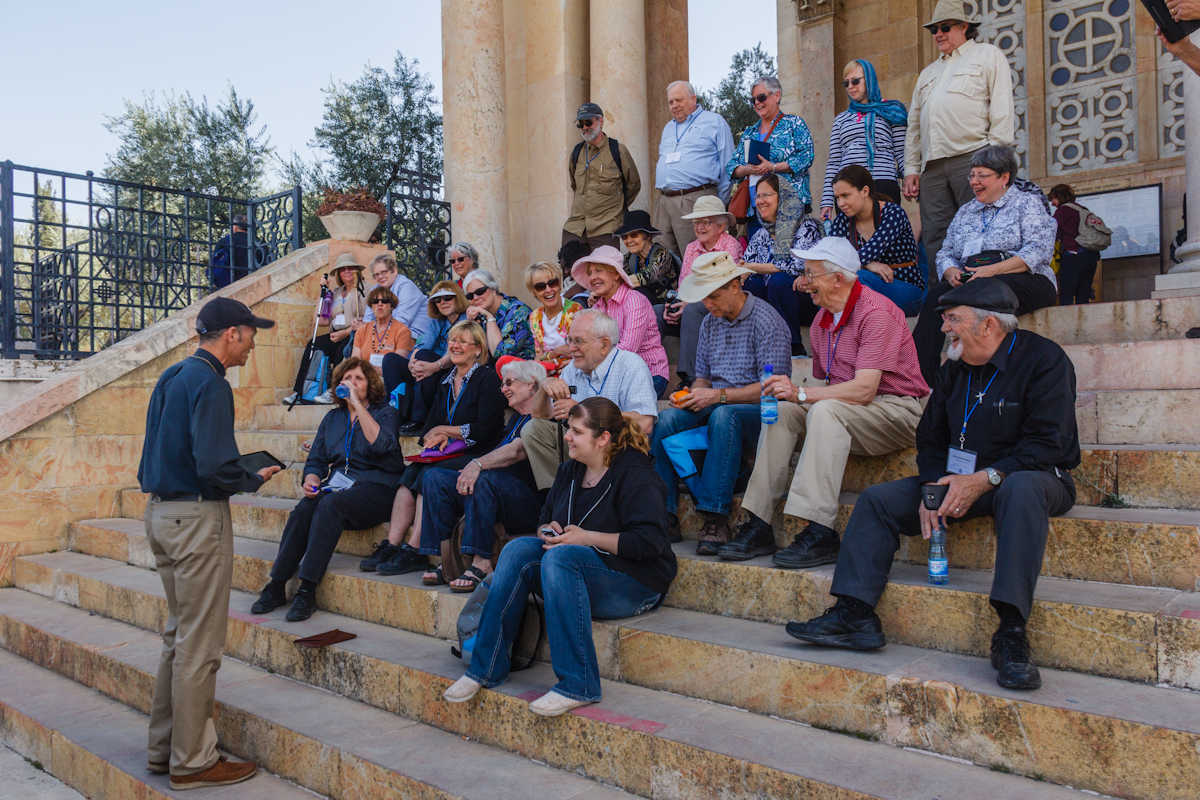
Join Bishop Julian and Brenda Dobbs for a very special and personal tour of the Holy Land with the guide of each of the Bishop’s previous tours. Dates: November 5-16, 2015
Reserve your place now! 
For details contact Brenda Dobbs: Brenda.Dobbs@canaConvocation.org
Testimonies from the 2014 Tour:
For the pilgrimage of our lifetime, Bishop Julian and Brenda packed 33 of us neatly into 10 incredible, intensive days of history, ruins, Jesus’ life and ministry, prayer and shopping. Frances, our talented and very knowledgeable guide, held us to a tight schedule, making sure we saw every aspect of her well-balanced, detaileditinerary, right down to the hotels and restaurants. Haleed, our talented bus 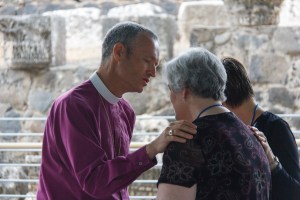 driver, maneuvered us expertly around tight corners as we held our breath. They became like family to us. Some of us had our feet washed for the first time in the Upper Room. How cool to be able to say that! There was no mistake in God assembling us all for this trip; it was healing on many different levels. If you are fortunate enough to go on this Holy Land Pilgrimage, you will not be disappointed. Make sure you look for, and find, the hearts! Mrs. Lois Chiovolini
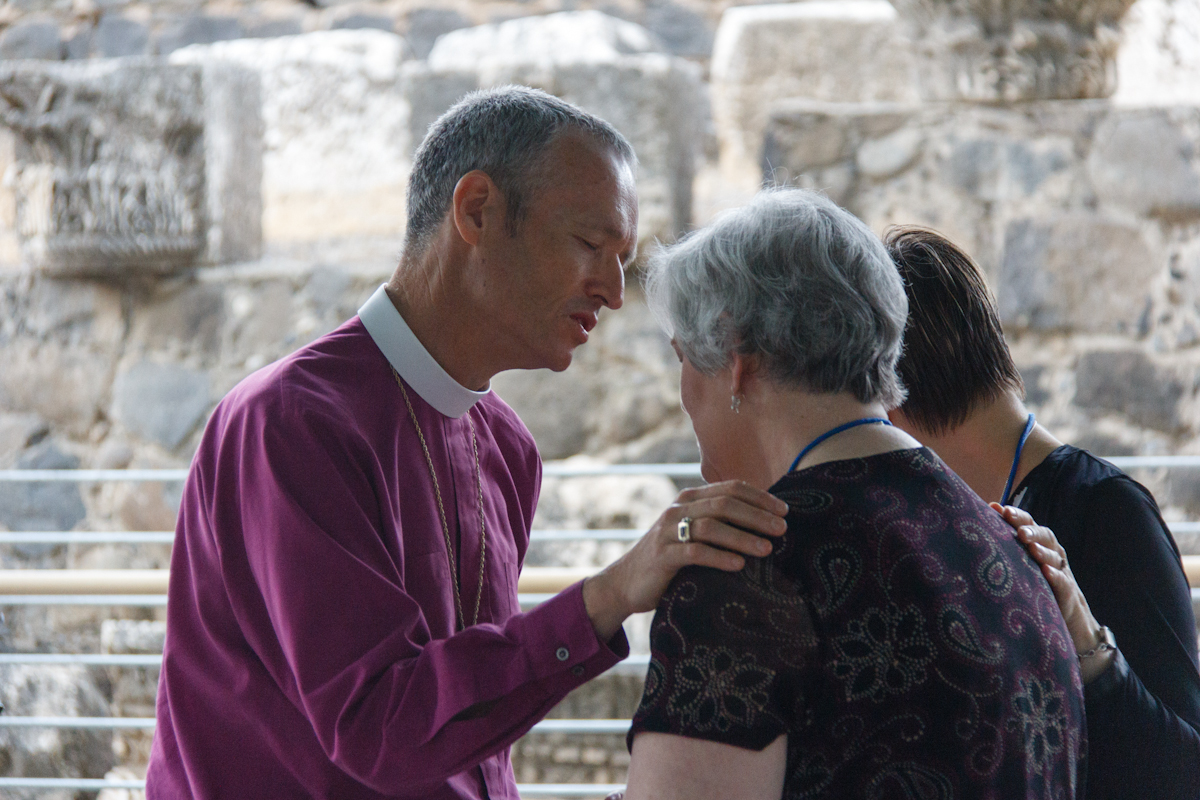 driver, maneuvered us expertly around tight corners as we held our breath. They became like family to us. Some of us had our feet washed for the first time in the Upper Room. How cool to be able to say that! There was no mistake in God assembling us all for this trip; it was healing on many different levels. If you are fortunate enough to go on this Holy Land Pilgrimage, you will not be disappointed. Make sure you look for, and find, the hearts! Mrs. Lois Chiovolini
One very import result of going on a trip like this to the Holy Land is how it enables you to visualize names and places that were once only words. Now, when I read about places like Jerusalem, the Temple, the Temple Mount, the Kidron Valley, the Mount of Olives, Gethsemane, and Galilee, just to name a few, they are accompanied by images that are 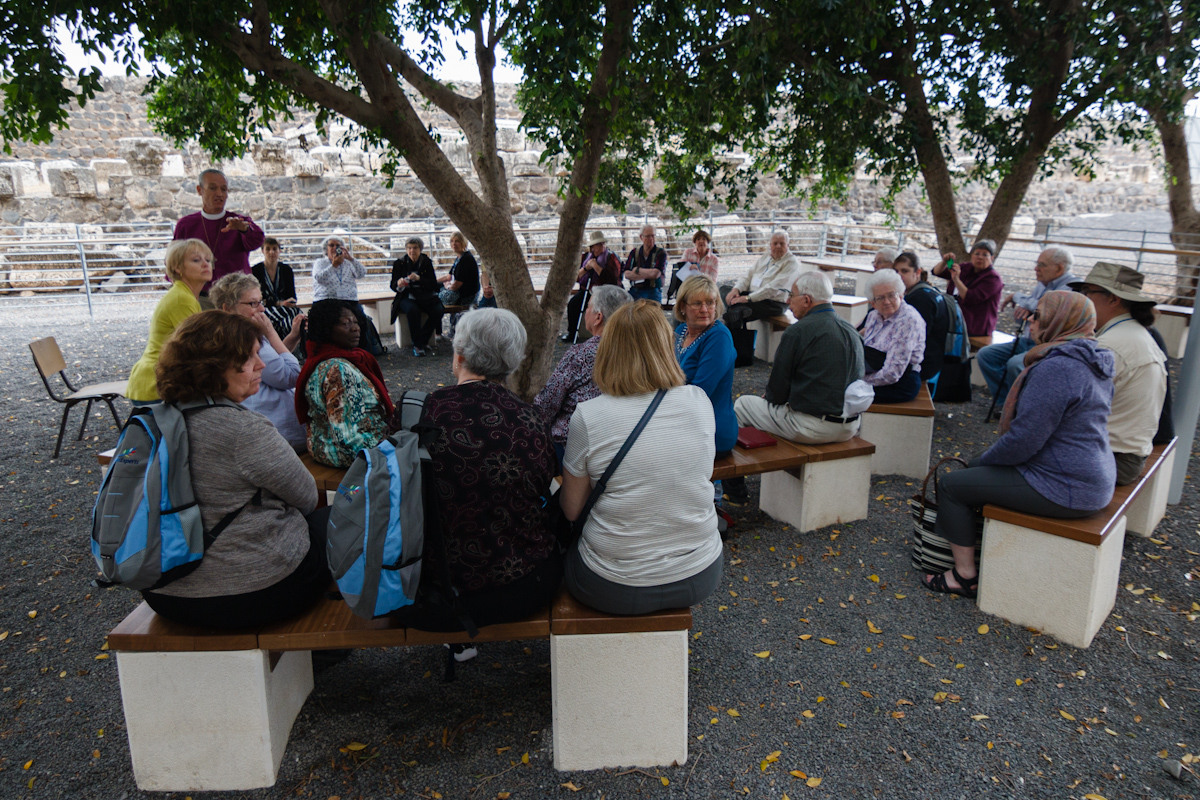 bursting with visual impact. I am now transported to the actual places of the Bible as I read them! I can also comprehend the relative distances between towns and villages that I couldn’t before…smell the market places…breath in the salt air of Joppa and Caesarea…feel the salty oiliness of the Dead Sea…be embraced by the barren isolation of Qumran and Masada. Not even after years of Bible College and Seminary was I able to grasp such knowledge. I heartily recommend this trip to you for the strengthening and deepening of your faith! Archdeacon Wayne Buchanan++
Life Beyond the Grave
Life Beyond the Grave: What Happens When you Die?
In conjunction with the Diocese of the Armed Forces and Chaplaincy, Bishop Julian Mark Dobbs, Missionary Bishop of CANA, presents an online video teaching series for Lent 2015.
Bishop Dobbs says, “We are all interested in life beyond the grave and what happens to a person at the point of death. This series will allow us to study what the Bible says about life beyond the grave and what happens when we die?”

Part 1 – Hades: What is Hades and what happens when you die? Luke 16
Part 2 – Hell: Eternal torment or medieval myth? Matthew 8, Matthew 13, Matthew 22, Luke 13
Part 3 – Heaven: A place prepared by Jesus. John 14
Part 4 – Judgment: The books will be opened; who will be judged? Revelation 20
Part 5 – Questions and Answers
A meeting with the State Department
The State Department told me this week that persecuted Assyrian Christians, who are losing their lives at the hands of Islamic terrorists, have no mechanism of direct access to the United States.
Perhaps we did not learn the lesson of history when in a highly publicized event in May–June 1939, the United States refused to admit over 900 Jewish refugees who had sailed from Hamburg, Germany. History tells the story of what awaited these refugees upon their return to Germany.
Are not liberty and justice the great attributes of American society that we must export to the world?
Much shame on the Department of State!
Please pray for Assyrian Christians.
10 Years On!
Ten years ago today, a massive earthquake and tsunami struck just off the coast of Aceh, Indonesia. Over 200,000 people in the region were killed. I visited Aceh just days after the Tsunami and made a number of subsequent visits in an attempt to assist suffering Christians.
Here is my initial video report from 2006. (Note: video contains images that some people might find disturbing)
National Cathedral to host Muslim prayer co-sponsored by Hamas-linked CAIR and ISNA
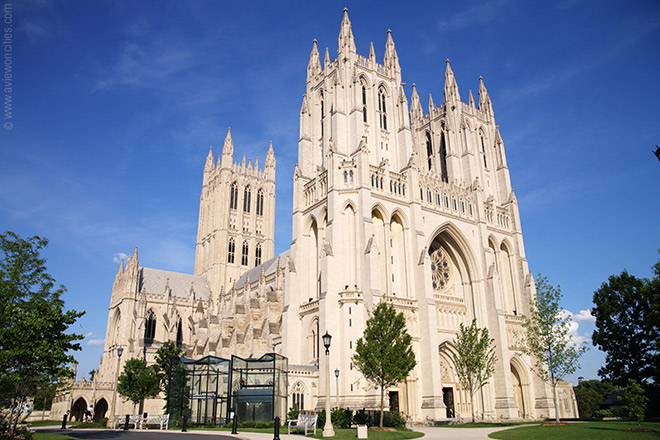 Jihad Watch has alerted us that Washington National Cathedral, known for hosting presidential funerals and other major spiritual services, will for the first time host weekly Muslim prayer services this coming Friday.
The Cathedral, part of the Episcopal Church, has long held high-profile interfaith events, and some mosques hold services in synagogues or churches if they need overflow space. But organizers said Monday that they are seeking to make a statement by having Muslim leaders come and hold their own midday services in such a visible Christian church.
“We want the world to see the Christian community is partnering with us and is supporting our religious freedom in the same way we are calling for religious freedom for all minorities in Muslim countries,” said Rizwan Jaka, a spokesman with the prominent ADAMS mosque in Sterling, one of the co-sponsors of Friday’s prayers. “Let this be a lesson to the world.”
Why Christianity Is Vital to the Middle East – Bishop Julian Dobbs
And he made from one man every nation of mankind to live on all the face of the earth, having determined allotted periods and the boundaries of their dwelling place. Acts of the Apostles, chapter 17, verse 26.
Christianity is intrinsically linked to the Middle East. It is in the Middle East that Christianity was birthed in the backwaters of the Roman Empire and from where the message of the Christain gospel spread throughout the Roman Empire, to Ethiopia, and to the Persian Empire. The missionary endeavors of the Church of the East brought Christianity even further, beyond Persia and Arabia, to Central Asia, India, and China. The Greek language was initially the main vehicle and then also the Syriac language, a dialect of Aramaic. The latter language allowed the development of strong literary traditions in Syrian Christianity; particularly poetry and liturgy [that remains in use today], and also teaching on theology.[1]
Last week, a series of unprecedented meetings and events were held in London, England where Anglican Archbishop of Canterbury, The Most Rev. Justin Welby, hosted leaders and representatives of churches of the Middle East and the wider Christian Church in Britain, at Lambeth Palace. After discussing the plight of Christians and minority communities in Iraq, Syria and the wider Middle East, the Archbishop read from an agreed statement expressing solidarity with, and advocating for, all those who continue to suffer gross violations of the fundamental right and freedom to practice their chosen faith. He said “The Middle East is the birthplace of Christianity, and home to indigenous Christian communities that have been an indispensable part of its history. Despite the challenges, Christians in the region were and are a stabilising and reconciling presence.”[2]
The Archbishop of Canterbury is to be commended in his advocacy for the right of religious freedom and the important place of Christianity in the Middle East. However, today as in history, the existence of Christians in the Middle East, the birth place of Christianity, is being threatened by the rise of a resurgent Islam.
In the 7th century, the growth of Islam changed the political, social and religious landscape of the region. Christians quickly lost large swathes of territory to Muslims, and from the religion of the State, Christianity turned into the religion of minorities. Christians became subordinates or dhimmis under the Islamic law. They had to pay special tax, jizya, and they often faced forced conversion to Islam. Ironically however, Christians of the Middle East are recognized as indispensable conduits of culture, knowledge, literature, philosophy and science to Muslims. It is in fact the Christians who enriched the Muslim civilization, among other things with Greek philosophical texts that they dutifully translated into Arabic (not surprisingly so, since Christians were fluent in both Greek and Arabic).[3]
While Christians under the Muslim rule had periods of relative security and protection, they also experienced intense persecution and brutality. The events of the late 19th – early 20th century made the Christians of the Middle East particularly vulnerable and they became one of the most uprooted communities. This dramatic dispersion and relocation of 19-20th century was due to the Damascus massacre of 1860, the Armenian Genocide of 1915 and the expulsion of Pontian Greeks in 1922.
Sadly, these were not merely incidental, isolated events but they became a continuum, a systematic process of eliminating Christian community in the Middle East. War crimes, massacres, persecution and harassment caused a continuous exodus of the Christians and a drastic decline in numbers of a once dominant community.
This has been a very sad development, as Christians have been making important and valued contributions to the cohesion of society in the Middle East. The founder of Ba’ath Party, Michel Aflaq, as well as George Habash, and Antun Sa’adeh, all Christians who amongst others, played an important role in the Arab nationalism, a stabilizing force in the Middle East,[4] promoting the ideas of Arab inclusiveness, national awakening and a moderating impact on politics and society. Their transformative contribution also extended through education and business, and their Muslim neighbors historically appreciated this:
…many say it’s important to maintain Christian communities in the Middle East. They see the quality of their schools; their contributions as entrepreneurs, merchants, and as overwhelmingly middle- or upper-class consumers; and the religious plurality they inevitably bring as essential and enriching to Arab society.[5]
By playing a constructive and balanced role in the society, the Christian community in the Middle East served as social glue in the multi-cultural and multi-ethnic society. Scholars have long agreed that Christianity has been the engine driving social progress in the region.
Of serious consideration is the important, and yet fading link between the ancient church in the Middle East and the modern-day Christian community worldwide. Their lonely fate is tragic not only because their history has been “lost” or forgotten, as Philip Jenkins aptly describes in his book The Lost History of Christianity.[6] They have also been largely neglected as a community by the Western Church, despite their history, survival and perseverance in the Middle East. Western governments rarely factor into their regional strategies the Christians of the Middle East, though they have been living in the region since the dawn of Christianity. As a struggling minority, Christians have also been facing the brunt of conflict and insurgency. It was the Christian community who was targeted over the ouster of Mohammad Morsi, the pro-Muslim Brotherhood president of Egypt in 2013. Churches were set on fire in the Minya province, and Christians were systematically and violently attacked. Atrocities committed by ISIS in Iraq and Syria only plunged the region, and its Christian minorities, into a deeper crisis. All too often the plight of Christians is now described as a looming ‘genocide’ and ‘extermination’, irrevocable and brutal.
A close parallel to the current dramatic demographic changes in the region is the exodus of the Sephardi and Mizrahi Jewish community from the Middle East from 1948 onwards. Jews have been living in the MENA region since antiquity, mostly as a tolerated or suppressed minority. This left a mark that Mordechai Nisan defines as ‘the dhimmi syndrome’:
For Galut [exile or diaspora] is an inner psychological domain, feebleness and fear, a loss of dignity more than just a lack of power, all derivative from centuries of persecution and homelessness. It is shame of oneself and in front of others. [7]
Nisan argues further that it is Zionism that was there to help to deal with this syndrome, and turn Jews from feeling inferior to feeling proud. While the State of Israel and Zionism are highly politicized, lessons can still be learned from the experience of the Jewish community in the Middle East. The self-image of the ‘protected/ persecuted minority’ and recent experience of expulsion, flight and relocation of Christians in the Middle East has traumatic and long-standing consequences. The fact that the plight of fleeing Christians and other minorities received mostly silent responses from western governments only adds to their sense of abandonment and despair. Even the media would rather emphasize the recent assault on Yazidi community over similarly brutal and systematic attacks on the Christian community.
While the West is often proud to celebrate its richness and diversity, the Middle East is on a path to become homogeneous and uniform. Not only is this an enforced unnatural uniformity in the ancient lands also known as the ‘cradle of civilizations’, it is also a very costly. The price is the exodus of its minorities and the eradication of their legacy, as is the case with atrocities in Iraq and Syria. It is a break in the continuation and transmission of the tradition of Eastern Christianity, a branch of Christianity where traditions are critical. It is a ruthless and forceful disruption of the religious community, their infrastructure (e.g. churches, monasteries), liturgy, rites and celebrations, and even language (e.g. Aramaic), all of which have existed for centuries if not millennia. Once the heritage of Christians in the Middle East is obliterated, their status as dhimmis is reinforced.
If Christians are eradicated from the region, so is the eastern Christian civilization. This will be detrimental to the Middle East. The cost is considerably higher, as it is not only about forced expulsion and violence against Christians, but against anyone who is ‘other’. There is no guarantee that with the exodus of Christians and other minorities, the followers of the radical ideology will not turn on others whom they deem inferior or not proper Muslims. If the West does not respond, the East is bound to descend into even graver chaos.
A poem by Ephrem the Syrian, one of the fathers of the Syriac church, a prominent theological and poet.
Receive, O Lord, in Heaven above
Receive, O Lord, in Heaven above
Our prayers and supplications pure;
Give us a heart all full of love
And steady courage to endure.
Thy holy name our mouths confess,
Our tongues are harps to praise Thy grace;
Forgive our sins and wickedness,
Who in this vigil seek Thy face.
Let not our song become a sigh,
A wail of anguish and despair;
In loving kindness, Lord most high,
Receive tonight our evening prayer.
O raise us in that day, that we
May sing, where all Thy saints adore,
Praise to Thy Father, and to Thee,
And to Thy Spirit, evermore.
Ephrem the Syrian[8] “In many ways the poem became for the Syrians what the icon was to become for the Greeks.”[9]
I firmly believe that religious freedom and security in the Middle East are directly connected to the continuing strong, faithful and growing presence of Christianity in the region. Speaking in New York on the 29th of December 1949, Jacques Maritain, French Catholic philosopher and prominent drafter of the Universal Declaration of Human Rights wrote, in times of scandalous triumphs of falsehood and violence, an heroical inspiration and belief are needed, which is found in ‘none other than Jesus of Nazareth’.[10] Ultimately, Christianity is vital to the Middle East because it is only through Jesus Christ that a world racked with violence and pain will find everlasting peace with Almighty God. There is salvation in no one else, for there is no other name under heaven given among men by which we must be saved.[11] This is why Christianity will always be vital to the Middle East.
It is our responsibility to act and to raise our voices on behalf of Christians in the Middle East, their right to remain in their ancient, biblical and historic communities and to protect their valuable contribution to the Church and global civilization.
[Delivered on 9/11/2014 at the inaugural conference of In Defense of Christians]
http://www.indefenseofchristians.org
[1][1] Christopher Dawson,The Formation of Christendom. New York: Sheed and Ward, 1967, p. 150.
[2] http://www.archbishopofcanterbury.org/articles.php/5403/archbishop-of-canterburys-statement-on-mid-east-christians
[3] Dimitri Gutas, Greek Thought, Arabic Culture: The Graeco-Arabic Translation Movement in Baghdad and Early ʻabbāsid Society (2nd-4th/8th-10th Centuries). London: Routledge, 1998, p. 3.
[4] Mitri Raheb, I Am a Palestinian Christian. Minneapolis: Fortress Press, 1995, p. 40.
[5] Christa Case Bryant, ‘What the Middle East would be like without Christians’, 22 December 2013, www.csmonitor.com/World/Middle-East/2013/1222/What-the-Middle-East-would-be-like-without-Christians (viewed 29 August 2014).
[6][6] Philip Jenkins, The Lost History of Christianity: The Thousand-Year Golden Age of the Church in the Middle East, Africa, and Asia and How It Died. New York: HarperOne, 2008.
[7][7] Mordechai Nisan, Minorities in the Middle East: A History of Struggle and Self-Expression, 2nd edition. Jefferson, N.C: McFarland, 2002, p. 265.
[8] Thomas Oden and Cindy Crosby, Ancient Christian Devotional: A Year of Weekly Readings Cycle C. Downers Grove, Ill: IVP Books, 2009, p. 110.
[9] Kenneth Parry and John R. Hinnells, The Blackwell Dictionary of Eastern Christianity. Oxford: Blackwell Publishers, 2001, p. xv.
[10] http://www3.nd.edu/Departments/Maritain/jm604a.htm
[11] Acts of the Apostles chapter 4, verse 12
 julian dobbs